
When buyers and brands search for “Italian soccer brands,” the intent often splits. Some seek to license or source authentic, heritage team kits from iconic manufacturers like Kappa or Admira. Others are hunting for the aesthetic—the sleek, performance-driven, fashion-forward style associated with Italian design—to incorporate into their own custom activewear lines. This guide bridges that gap, analyzing the landscape from a manufacturing and OEM/ODM perspective. We’ll break down what defines this category, the practical realities of sourcing products with this aesthetic, and key decision points for your custom production run.
Whether you’re a gym owner wanting premium tracksuits, a fashion brand developing a soccer-inspired capsule, or a sports team needing authentic-feel jerseys, understanding the nuances of “Italian soccer” as a product category is critical for navigating production, quality, and cost.
In this guide:
- The Two-Tier Market: Heritage kit makers vs. fashion-forward sportswear labels.
- Key Signature Features: Fabrics, cuts, detailing, and branding that define the look.
- Sourcing Strategies: OEM vs. ODM, typical MOQs, and production considerations.
- Quality & Compliance: What to request from your factory to ensure authentic-feeling results.
- Decision Framework: How to choose the right approach for your brand and budget.
Deconstructing the Category: Heritage Kit vs. Fashion Aesthetic
The term “Italian soccer brand” primarily references two distinct types of companies, and your sourcing strategy depends entirely on which one aligns with your goals.
1. The Heritage Kit Manufacturer
These are the historic, often family-owned, companies that have supplied official kits to Serie A and national teams for decades. Examples include Kappa (famous for its “Omini” logo), Admira (known for its tight, performance fits), and Lotto (pioneer of the tennis-inspired soccer shoe). Their identity is inextricably linked to the sport itself.
Sourcing Reality: Engaging these brands for custom production is typically a high-volume, licensed, or co-branded wholesale relationship. They operate massive, certified factories with stringent quality controls. Minimum Order Quantities (MOQs) are very high, often starting at 5,000+ pieces per style for custom colorways, with complex certification requirements for official team branding (e.g., FIGC or UEFA approvals). For most small-to-mid-sized buyers, direct OEM with these entities is not feasible.
2. The Italian-Design Fashion Sportswear Label
This is a broader, more accessible category for custom sourcing. It includes brands like Stone Island (with its Shadow Project soccer line), Moncler (lifestyle outerwear), Dolce & Gabbana (which has done high-fashion soccer collabs), and even technical brands like Napapijri. Here, “soccer” is an inspiration—a design language applied to tracksuits, jackets, and casual tees. The focus is on premium fabrics, minimalist branding, and urban utility.
Sourcing Reality: This is the sweet spot for OEM/ODM. Many factories in Italy, Portugal, and increasingly Tunisia and Eastern Europe, specialize in producing garments that mimic this aesthetic. They work with buyers to replicate the feel of an Italian fashion sportswear piece: curved hems, tonal stitching, specific rib knits, and discrete logos. This is where a custom manufacturer can offer you the “Italian soccer brand look” without the heritage brand’s licensing or MOQ constraints.
Defining Features to Specify in Your Custom Order
To communicate the “Italian soccer” aesthetic to a factory, you must move beyond vague terms. Specify these tangible elements:
| Feature | Heritage Kit Characteristic | Fashion Sportswear Characteristic | What to Ask Your Manufacturer |
|---|---|---|---|
| Fabric | Lightweight, breathable technical mesh or polyester (e.g., 100% polyester, 140gsm). | Heavyweight French terry, brushed fleece, technical twill, or wool-blends. Focus on hand-feel and drape. | “Can you provide fabric swatches for a 320gsm brushed fleece with a peached finish, similar to high-end Italian tracksuits?” |
| Fit & Cut | Skinny or athletic “second-skin” fit for performance. | Relaxed, oversized, or tailored-but-comfortable. Often features curved hem, dropped shoulders, and longer sleeves. | “We need a pattern with a 4cm dropped shoulder and a curved back hem. Can you provide a tech pack with these measurements?” |
| Branding & Details | Large, bold crests, player names, sponsor logos (often heat-transfer or embroidery). | Subtle, tonal embroidery, small woven labels, unique zip pulls, contrast piping, or branded buttons. | “We want a 5cm tonal embroidered logo on the left chest and a branded rubber tip on the drawstring. What is the MOQ for custom woven labels?” |
| Construction | Flatlock seams for chafe prevention, minimal pockets. | Heavy-duty stitching, multiple pocket styles (zip, flap, kangaroo), reinforced stress points. | “Specify chainstitch on all main seams and YKK® zippers. Can you source the specific zipper pull design we’ve attached?” |
Sourcing Pathways: OEM, ODM, and What to Expect
Your choice between Original Equipment Manufacturing (OEM) and Original Design Manufacturing (ODM) will dictate cost, control, and timeline.
- OEM (Your Design, Their Production): You provide complete tech packs, specifications, and samples. This offers maximum control but requires design expertise and higher upfront sampling costs. Ideal for brands with a clear, proprietary vision. Expect MOQs of 300-500 units per style for quality-focused factories.
- ODM (Their Design, Your Branding): You select from the factory’s existing catalog of proven styles—often their interpretations of Italian soccer fashion trends. You then customize labels, colors, and minor details. This drastically reduces development time and cost (minimal sampling fees) and is perfect for retailers or startups testing the market. MOQs can be as low as 50-100 units for basic items.
Critical Communication: When requesting quotes, always provide visual references (e.g., “like this Stone Island jacket but with a kangaroo pocket”) and a detailed tech pack. Specify fabric composition (e.g., 80% cotton, 20% polyester), weight (gsm), and desired finishes (e.g., garment-dyed vs. piece-dyed). Ambiguity leads to sampling errors and cost overruns.
You may also like: What Are Cargo Pants Made Of? A Fabric Guide for Brands & Buyers
Quality Markers & Production Realities
An “Italian feel” is in the details. A good custom manufacturer will understand these benchmarks:
- Fabric Sourcing: Authentic-feeling production often uses Italian mills (e.g., Marzoli, Tollegno 1900) or their equivalent. Ask about mill origin. Japanese or Korean polyester can also offer excellent hand-feel.
- Trim & Labels: Woven labels should be tight-weave and soft. Hangtags should be substantial (e.g., 300gsm cardstock). Zippers should be from recognized brands like YKK® or SBS®.
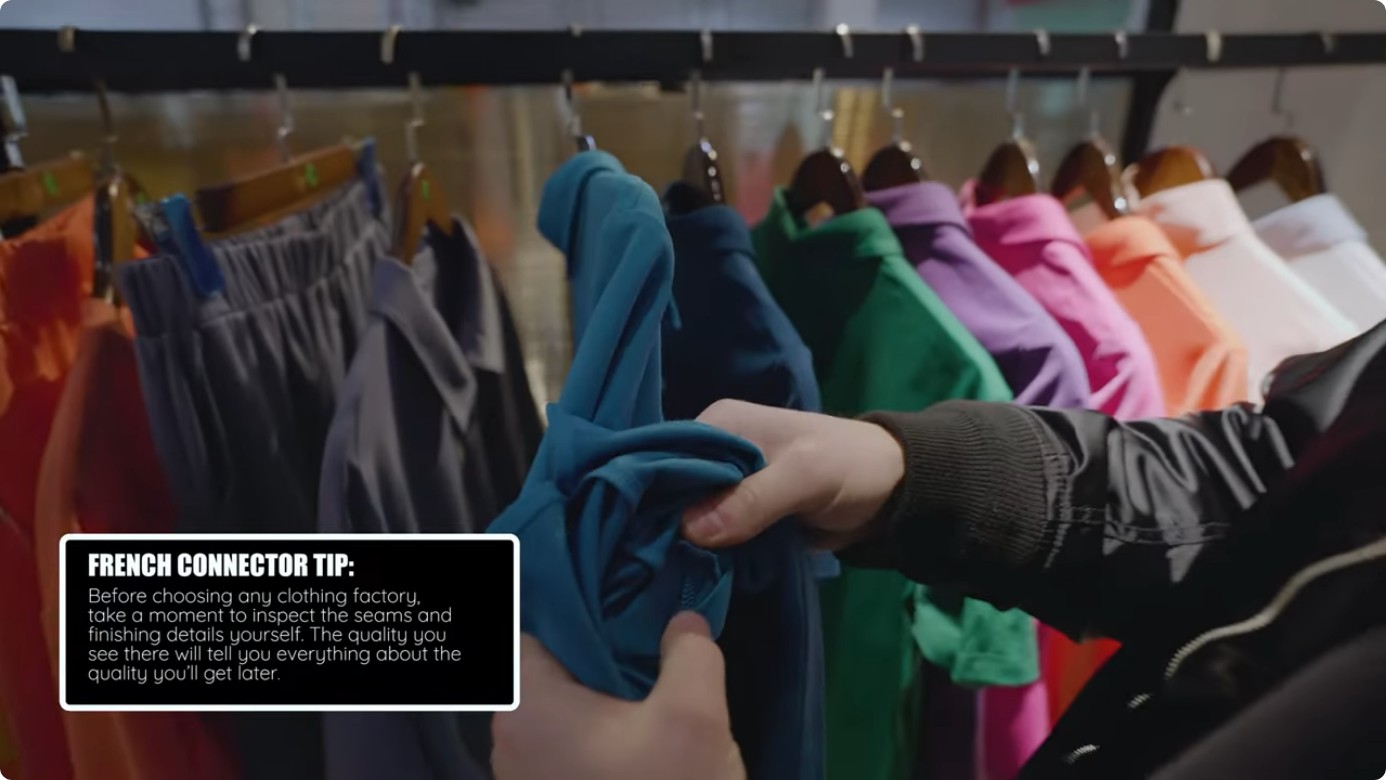
- Stitching: Look for consistent, straight stitching with no loose threads. Topstitching should be precise and decorative.
- Fit Consistency: Request a pre-production sample (PP sample) and have it modeled or fit-tested. Sizing consistency across a large run is a key differentiator between a good and great factory.
Trade-off Alert: True Italian manufacturing carries a significant price premium. For budgets under $40/unit retail, look to Portuguese, Tunisian, or Turkish factories that specialize in mid-to-high-end sportswear and have experience replicating Italian construction techniques. Always request a sample from the proposed production line, not just a prototype.
Decision Checklist for Buyers
Before engaging a factory, clarify these points:
- Target Market: Is this for performance athletes (need technical fabrics, breathability) or lifestyle consumers (need premium hand-feel, fashion details)?
- Budget & Price Point: What is your landed cost target? This dictates fabric, trim, and manufacturing location choices.
- Order Volume: Be realistic. For a first order with an ODM-style approach, 200-500 pieces per style is a common starting point for quality factories. For full OEM, plan for 500+.
- Timeline: Custom OEM with sampling can take 12-16 weeks. ODM can be 8-10 weeks. Factor in fabric sourcing and shipping.
- Compliance: Will your garments need to meet specific standards (e.g., OEKO-TEX® Standard 100 for safety, or specific country import rules)? State this upfront.
Frequently Asked Questions
Can I get a custom jersey made that looks like an official Italian national team kit?
You can create a custom jersey with a similar aesthetic (e.g., featuring the Italian flag colors, a sleek collar, and performance fabric) but you cannot replicate official team trademarks (the FIGC crest, specific player names, or exact licensed patterns) without a formal licensing agreement. Factories will refuse such requests due to legal risk. Focus on generic “Italia” or “Azzurri” themes and original design elements.
What is a realistic MOQ for a custom tracksuit with an Italian fashion feel?
For a decent quality track jacket and pant set using mid-range fabrics and standard branding (woven label, screen print), expect an MOQ of 300-500 pieces per style from a reputable factory. If you opt for more complex details like custom hardware, all-over embroidery, or special fabric treatments, MOQs may rise to 1,000+.
How do I verify a factory’s ability to produce “Italian-quality” garments?
1) Request Physical Samples: Never rely on photos. Pay for a pre-production sample. 2) Audit Their Portfolio: Ask for examples of past work for European or premium American brands. 3) Ask About Their Mill Relationships: Factories with direct relationships with Italian textile mills have a significant advantage. 4) Visit if Possible: For orders over $50k, a factory audit is a wise investment.
We manufacture all the styles discussed in this guide — with custom labels, fabric options, and print or embroidery finishing. Tell us what you need.