
Kids & Children’s Clothing Manufacturer
Fexwear is a kids and children’s clothing manufacturer producing t-shirts, hoodies, joggers, sets, dresses and babywear in soft, skin-friendly fabrics – with the safety, sizing and durability parents expect. With low MOQ, custom prints and labels, and full sizing from newborn to teen, we help kidswear brands, boutiques and licensees build ranges that are as safe as they are cute.
This guide covers the safety rules that make children’s clothing different, the fabrics and sizing that matter, and how to brief a kids’ range.
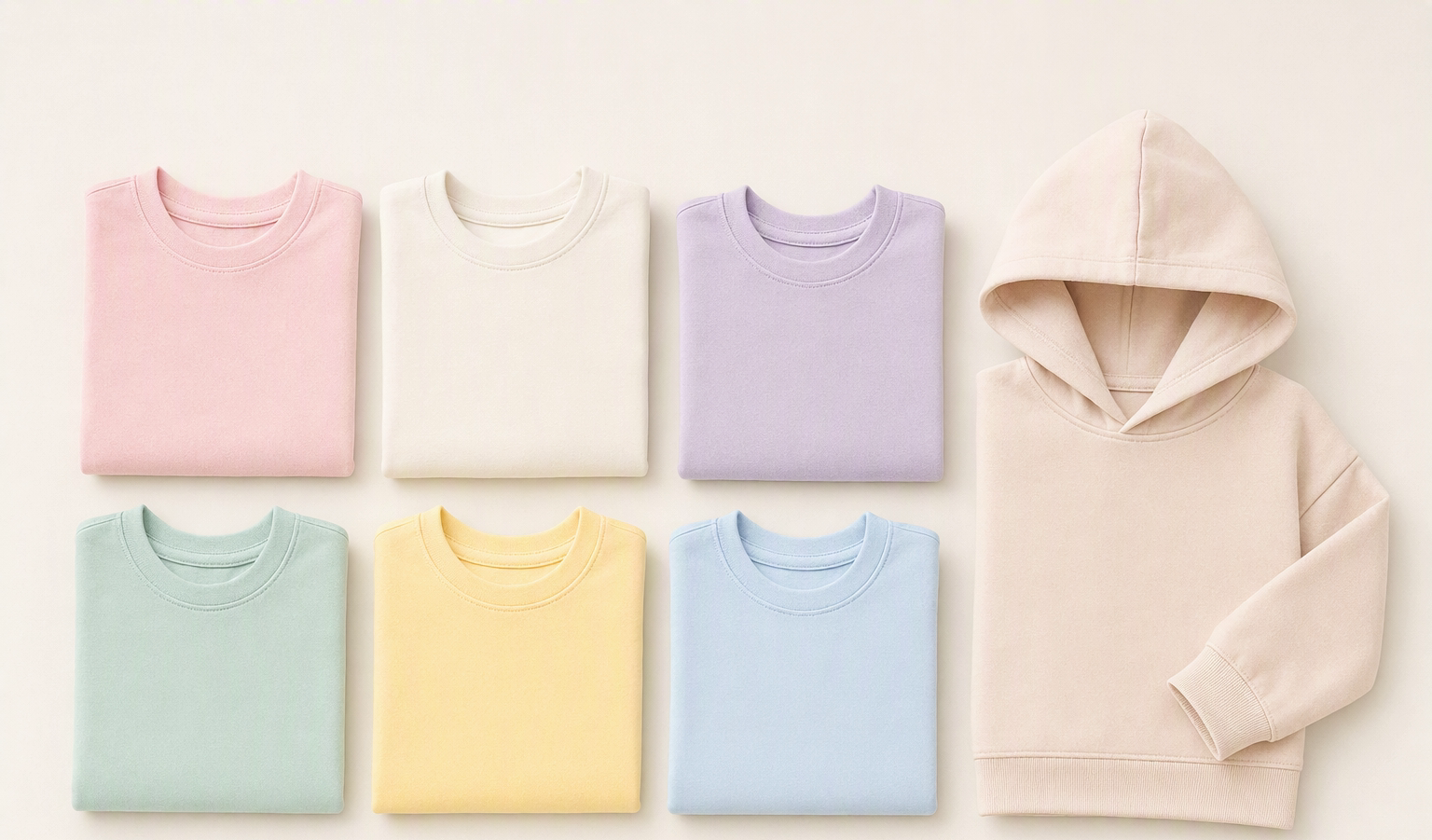
How to choose a kids’ clothing manufacturer
A low unit price means little if quality drifts between batches or the supplier disappears when something goes wrong. When you shortlist kids’ clothing suppliers, judge them on control and communication as much as cost:
- Real factory vs middleman – can they show production lines and control the process?
- Fabric knowledge – they should advise on GSM, blend and finish for your use case.
- Sample discipline – a proper pre-production sample before bulk.
- Decoration durability – logos that survive washing; ask how they test.
- Sizing & grading – consistent measurements across the size run.
- Lead-time honesty – realistic dates beat optimistic ones.
A practical test: ask each supplier for a fabric swatch card and a recent sample of comparable kids’ clothing. A real factory produces both quickly and can explain every choice; a reseller stalls or forwards generic photos. Also ask who owns the sewing lines – if the answer is vague, you’re paying a middleman’s margin on top of the risk.
Finally, weigh responsiveness against price. A supplier 5% cheaper who takes a week to answer will cost you more in missed seasons than a partner who replies the same day. The brands that win treat their manufacturer as part of the team, not a line item.
Where to source: Fexwear vs Alibaba vs local
| Channel | Pros | Cons |
|---|---|---|
| Fexwear (direct factory) | In-house control, low MOQ, free design, direct pricing | Pre-production sampling takes a few days |
| Alibaba / marketplace | Huge choice, low list prices | Variable quality, middlemen, hard to verify, MOQ surprises |
| Local manufacturer | Fast shipping, easy visits | Higher unit cost, limited fabrics & decoration |
The risks of sourcing from Alibaba (and how to avoid them)
- Middlemen posing as factories – many ‘manufacturers’ subcontract, adding cost and cutting you off from the line.
- Inconsistent, uncontrollable quality – it varies between suppliers and even between batches.
- Sample-vs-bulk bait-and-switch – the approved sample looks great, the bulk quietly changes.
- No accountability after payment – chasing fixes or refunds is slow and often fruitless.
- Misrepresented materials & certifications – claims that can’t be backed by certificates.
- MOQ and price surprises – list prices that jump once tooling and labels are added.
Alibaba can work if you verify the factory, insist on a pre-production sample and arrange independent QC – but a direct in-house manufacturer gives you comparable pricing with real production control and accountability on every batch.
Kids’ garments we manufacture
- Kids’ t-shirts & tops
- Hoodies, sweats & joggers
- Matching sets & tracksuits
- Dresses, skirts & leggings
- Babywear – rompers, bodysuits, sleep suits
- School & team wear
Kids’ clothing is its own discipline. Patterns must allow for growth and easy dressing, seams must be soft against skin, and trims must be safe – no loose cords, no small detachable parts on young children’s wear, no scratchy labels. We build to those constraints from the first sketch, not after a failed safety check.
2026 trends
- Soft hand-feel & garment-dyed cottons
- Matching sibling & family sets
- Organic & OEKO-TEX fabrics as a selling point
- Gender-neutral palettes
- Personalisation (names, numbers) for gifting
Construction & spec options
Every kids’ clothing is a set of decisions – pick each, or let us recommend a build for your price point:
| Spec | Options |
|---|---|
| Garment | Tee, hoodie, set, dress, romper, jogger |
| Fabric | Organic/combed cotton, cotton-elastane, fleece |
| Safety | No cords (young sizes), soft labels, secure trims |
| Size range | Newborn to teen (or custom grading) |
| Decoration | Water-based print, embroidery, safe appliqué |
Two decisions define a kids’ garment: fabric softness and safety compliance. We use skin-friendly, colourfast, low-shrink cottons and finish seams flat, and we design trims and prints to the relevant children’s safety standards so your range can be sold without worry.
Fabrics & GSM
Choose gentle, durable fabrics for active kids:
| Fabric | Typical weight | Best for |
|---|---|---|
| Combed / organic cotton jersey | 150-200 GSM | Soft tees & bodysuits |
| Cotton-elastane | 160-200 GSM | Stretch & comfort |
| Brushed fleece | 260-340 GSM | Hoodies & winter sets |
| Rib & interlock | varies | Necklines, cuffs, babywear |
What is GSM and how to choose fabric weight
GSM (grams per square metre) is the fabric’s weight – the biggest driver of how a garment feels. Lower GSM is lighter and cooler; higher GSM is denser, more opaque and more premium. For kids’ clothing, matching the weight to how it’s worn and washed is what separates a product people reorder from one they return.
| GSM range | Feel | Best for |
|---|---|---|
| 120-160 GSM | Very light, breathable | Summer & performance |
| 160-220 GSM | Mid-weight, soft | Everyday & lifestyle |
| 220-300 GSM | Heavy, structured | Premium & streetwear |
| 300+ GSM | Thick, luxe drape | Designer heavyweight |
Kids’ clothes get washed constantly, so favour durable, colourfast mid-weight cotton that softens without falling apart. Heavy enough to survive the laundry, soft enough for sensitive skin.
Blank vs private-label vs custom vs POD
| Model | What it is | Best for |
|---|---|---|
| Blank wholesale | Unbranded, you print | Fast, low-cost starts |
| Private label | Your fabric, fit & colours to spec | A signature product |
| Custom cut & sew | Developed from scratch | Full control & differentiation |
| Print-on-demand | Per-unit, no stock | Zero-risk testing |
Most brands start with blanks to test demand, then move to private label once a style sells. We support all paths, and many clients run two or three at once across different parts of a catalogue.
Decoration & branding options
| Method | Durability | Best for |
|---|---|---|
| Screen printing | High | Bold logos, bulk, spot colours |
| DTG (digital) | Medium-High | Detailed, multi-colour, small runs |
| Embroidery | Very high | Premium chest & label marks |
| Dye-sublimation | Permanent | All-over polyester performance prints |
| Heat transfer | Medium | Fast, low-cost, small batches |
For children’s wear, use water-based (PVC-free) prints and secure embroidery or appliqué – avoid small loose embellishments on young sizes. Names and numbers for teams and gifting are easy to add consistently.
MOQ, sampling & lead time
We keep MOQs low so you can test before committing. Sampling runs in stages – a proto sample, a fit sample, then a pre-production (PP) sample that locks fabric, colour and decoration. Standard samples turn around in days; bulk typically takes a few weeks once the PP sample is approved. Sample fees are usually credited against your bulk order, so testing costs little beyond the wait.
What drives the cost
- Fabric & GSM – performance and heavyweight fabrics cost more.
- Quantity – unit price falls as order size grows.
- Decoration – print size, colour count and embroidery complexity.
- Custom trims – woven labels, special elastics and packaging.
- Fit development – multiple sample rounds add time and cost.
- Logistics – destination, Incoterms and shipping method.
The quoted garment price is only part of the real cost. On top of it sits decoration, custom trims, packaging and freight, so always ask for a landed per-unit figure for the fully-branded product rather than comparing bare garment prices. Unit cost also falls with quantity, but not linearly – there’s a steep drop between a tiny test order and a real run, then it flattens, so order enough to reach the flat part for confident styles while keeping unproven ones at low MOQ.
What to send us for an accurate quote
Include: style reference or sketch, target fabric & GSM, size range and measurement chart, colours, logo artwork (vector if possible) and print method, quantity, and target price. No tech pack yet? Send a photo or a competitor example and our design team will build it with you. The more specific your brief, the tighter the price and the shorter the sample turnaround.
Sizing & measurement
Kids’ sizing varies wildly by market, so we grade to your target age/height chart and provide a clear size guide. Consistent sizing across a range is what makes parents reorder the next size up.
Sizing is a profit lever, not a detail: a garment that runs small or stretches unevenly drives returns, and returns eat margin twice – once in shipping, once in the unsellable unit. The fix is a clear, honest size chart with real garment measurements, consistent grading, and a fit sample checked on a body.
Quality control
Every run is checked at three points – pre-production (approved PP sample and materials), inline (during sewing and printing), and final inspection before packing. We inspect to an AQL standard (commonly 2.5 major / 4.0 minor defects for apparel) and photograph key checkpoints so you can see what we saw. You approve the PP sample, and that sample becomes the standard the whole order is judged against.
Sustainable options
Organic cotton and OEKO-TEX-certified fabrics are a strong fit for kidswear, where parents care about what touches their child’s skin. We can supply certified materials and the documentation to back your claims.
If sustainability matters to your buyer, decide early: recycled-polyester and organic-cotton options are the easiest wins and both can be certified. The key is paperwork – a GOTS or GRS scope certificate plus a transaction certificate for your specific order – because that’s what lets you legally and credibly put the claim on your hangtag.
Common mistakes to avoid
- Using adult safety assumptions on children’s wear (cords, small parts)
- Scratchy printed labels on baby garments
- Inconsistent sizing so the next size doesn’t fit
- Fabric that shrinks or fades after a few washes
- Over-elaborate decoration that fails safety or durability
The most common thread behind all of these is skipping the sample or over-ordering an unproven style. Test broadly with small quantities, watch what actually sells, then concentrate your budget on the winners – suppliers who push you to commit to volume before you have sales data are optimising for their schedule, not your cash flow.
Who we manufacture for
- Kidswear & children’s brands
- Boutiques & online retailers
- Baby & toddler labels
- Schools & kids’ sports teams
- Licensed & character ranges
- Gift & personalisation sellers
A premium baby brand needs organic cotton and no scratchy labels; a school needs durable, colour-matched kit in a wide size run; a gift seller needs reliable name-printing. We set fabric, safety and decoration to each – the same care, different briefs.
Why brands choose Fexwear
- Skin-friendly, safety-conscious construction
- Organic & OEKO-TEX fabric options
- Full newborn-to-teen sizing
- Low MOQ for emerging kidswear brands
- Durable, colourfast, wash-tested fabrics
The short version: you get factory-direct economics with the guidance of a partner who has made the mistakes so you don’t have to. We’ll tell you when a fabric will pill, when a print method is wrong for the garment, and when an order size is unrealistic – and we’ll still make it happen when you’re right.
Order timeline: enquiry to delivery
| Stage | Typical time |
|---|---|
| Enquiry & quote | 1-2 days |
| Proto / fit sample | 3-7 days |
| PP sample approval | 3-5 days |
| Bulk production | 2-4 weeks |
| QC & packing | 3-5 days |
| Shipping (air/sea) | 3-30 days by method |
Working to a launch date or a seasonal drop? Tell us the deadline up front and we’ll build the schedule backwards from it so you’re not air-freighting in a panic.
How to start
- Share styles, ages/sizes, fabrics & artwork
- We advise on safety & fabric choices
- Approve a sample
- Bulk production, QC & worldwide shipping
The safety rules that make children’s clothing different
Kidswear carries legal obligations adult apparel doesn’t. Drawstrings and cords are restricted or banned on young children’s garments because of strangulation risk; small parts must not detach and become choking hazards; and in many markets flammability and chemical (e.g. azo-dye, phthalate) limits apply. Getting these wrong isn’t a returns problem – it’s a recall and liability problem. We design to these constraints from the pattern stage and can point you to what to verify for your destination market, so your range is as compliant as it is cute.
Sizing, growth and the repeat purchase
Kidswear has a built-in loyalty engine: children grow, and parents come back for the next size. That only works if your sizing is consistent and predictable across the range and across reorders – the size 4 tee should relate cleanly to the size 6. We grade to a clear age/height chart and hold it stable, so a parent who loved your size 3 reorders size 4 with confidence. Nail the size curve and the category’s natural repeat cycle works for you.
Request a quote
Tell us your kids’ clothing, fabric and quantity and we’ll come back with pricing, MOQ and a timeline. Related: custom tank tops, white label and contact Fexwear →
Children’s safety standards you must design to
Kidswear carries legal obligations that adult apparel doesn’t, and getting them wrong is a recall, not a return. Drawstrings and cords are heavily restricted or banned on young children’s garments because of strangulation risk. Small parts – buttons, sequins, appliqué – must not detach and become choking hazards on under-3s. Many markets also cap flammability and limit chemicals like azo dyes, phthalates and nickel. We design to these constraints from the pattern stage and can point you to what to verify for your specific destination market, so your range is compliant before it’s cute.
This is where a specialist manufacturer earns their fee: a generalist activewear factory will happily make a hoodie with a long drawcord and only realise the problem at customs or, worse, at a customer’s house.
Fabric and construction for clothes that survive kids
Kids’ clothes endure more washing than anything else in the wardrobe, so durability and colourfastness are the real spec. We favour combed or organic cotton that softens without falling apart, low-shrink finishes so a size 4 is still a size 4 after ten washes, and flat, soft seams that don’t chafe sensitive skin. The neck label should be printed, not a scratchy sewn-in tag. These unglamorous choices are exactly what make a parent buy the next size up.
Building a kidswear range around the growth cycle
Kidswear has a built-in repeat engine: children grow, and parents return for the next size – but only if your sizing is predictable. That means a clear age/height size chart and consistent grading so a size 4 relates cleanly to a size 6 across every style. Plan your range as a capsule of mix-and-match pieces in a coherent palette, so a parent who loved one item buys the whole set, and the natural growth cycle becomes your retention strategy.
Making kidswear feel premium
The perceived quality of children’s clothing lives in the finishing – soft hand-feel, a proper ribbed neckline that doesn’t stretch out, reinforced shoulders for pulling over heads, gentle elastics, and thoughtful details like matching sibling pieces or a name label inside. These cost little and are exactly what a parent notices when they touch the garment, and touch is how kidswear is bought.
Prints and decoration that survive the kids’ laundry
Kids’ clothes are washed constantly, so decoration has to survive it. Water-based and discharge prints soften with the garment and won’t crack or peel; plastisol sits on top and breaks down faster; transfers can lift. For logos and small marks, embroidery is durable and premium. We match the decoration method to the fabric and the wash reality, and we test print adhesion on the sample – because a graphic that flakes off after five washes is a refund and a lost customer, in a category where parents talk to each other.
Building a kidswear capsule collection
The strongest kidswear ranges are tight capsules – a few core pieces in a coherent palette that all mix and match, rather than 30 disconnected styles. Capsules lower inventory risk, make it easy for parents to buy several pieces at once, and let you tell a clear seasonal story. Plan the core (tees, joggers, a hoodie, a set), add a couple of hero prints, and extend into colours that all coordinate. We help you build a range that sells in multiples.
Sizing and the growth cycle
Consistent, predictable sizing is the engine of kidswear repeat purchases. Children move up a size every few months, so a parent who trusts your fit becomes a recurring customer – but only if your size 4 today matches your size 4 next season and relates cleanly to the size 6. We grade to a clear age/height chart and hold it stable across reorders, so the natural growth cycle works in your favour.
Babywear specifics
Baby clothing has its own rules: envelope-neck bodysuits for easy dressing over a head that hates it, snap crotches for nappy changes, nickel-free and covered snaps, tag-free necks, and fabrics soft enough for skin that reacts to everything. Get these details wrong and a baby-gear brand loses trust instantly. We build babywear around the realities of dressing a squirming infant, not just shrinking an adult pattern.
Certifications parents trust
For kidswear, OEKO-TEX Standard 100 (no harmful substances) and GOTS (organic) are the certifications that reassure parents and let you make credible claims. Because children’s skin is more permeable, these matter more here than in adult apparel. We can supply certified fabrics and the documentation so your ‘gentle on skin’ promise is provable, not just marketing.
Personalisation and gifting in kidswear
Kidswear is a huge gifting market, and personalisation – a name on a bodysuit, a number on a birthday tee, a monogrammed set – lifts both margins and emotional value. It also suits low-MOQ production, because personalised pieces are made in small, high-value runs. We support name printing and embroidery consistently across a range, so a boutique or online store can offer gift personalisation without a complex setup, and capture the birthdays, showers and holidays that drive the category.
Sourcing kidswear responsibly
Beyond the product itself, ethical kidswear sourcing is about the factory: safe conditions, fair wages and no child labour, verified by audits like BSCI or SMETA. Parents increasingly care about who made their child’s clothes, and being able to answer honestly is a real advantage. We work to audited standards and can point you to what to verify, so your range is responsible from the fibre to the finished garment.
Glossary
| Term | Meaning |
|---|---|
| GSM | Grams per square metre – fabric weight |
| Tech pack | Spec sheet with measurements, fabrics & artwork |
| Proto / fit / PP sample | Prototype, fit-check and pre-production samples |
| Sublimation | All-over dye print fused into polyester |
| Serging / overlock | Seam finishing that prevents fraying |
| AQL | Acceptable Quality Level – inspection standard |
| Incoterms | Shipping terms like FOB, EXW, DDP |
| Cut & sew | Fully custom from fabric roll, not printing blanks |
Frequently Asked Questions
What kids' clothing can you make?
T-shirts, hoodies, joggers, matching sets, dresses, leggings and babywear including rompers and bodysuits.
Do you follow children's safety standards?
Yes – we design to kids' safety rules (cords, small parts, chemical limits) and can advise on your market's requirements.
What's the MOQ for kidswear?
Low MOQ, so emerging kids' brands can start small; larger runs improve unit price.
Can you use organic or OEKO-TEX cotton?
Yes – skin-friendly certified fabrics are ideal for children's wear, with documentation to back the claim.
What size range do you cover?
Newborn to teen, or custom grading to your target age/height chart.
Can you personalise with names or numbers?
Yes – water-based prints and embroidery for names, numbers and gifting, applied consistently.
How durable is kids' clothing from you?
Built for constant washing – colourfast, low-shrink cottons with flat, soft seams.