
Custom Tie Dye Clothing Manufacturer & Wholesale Supplier
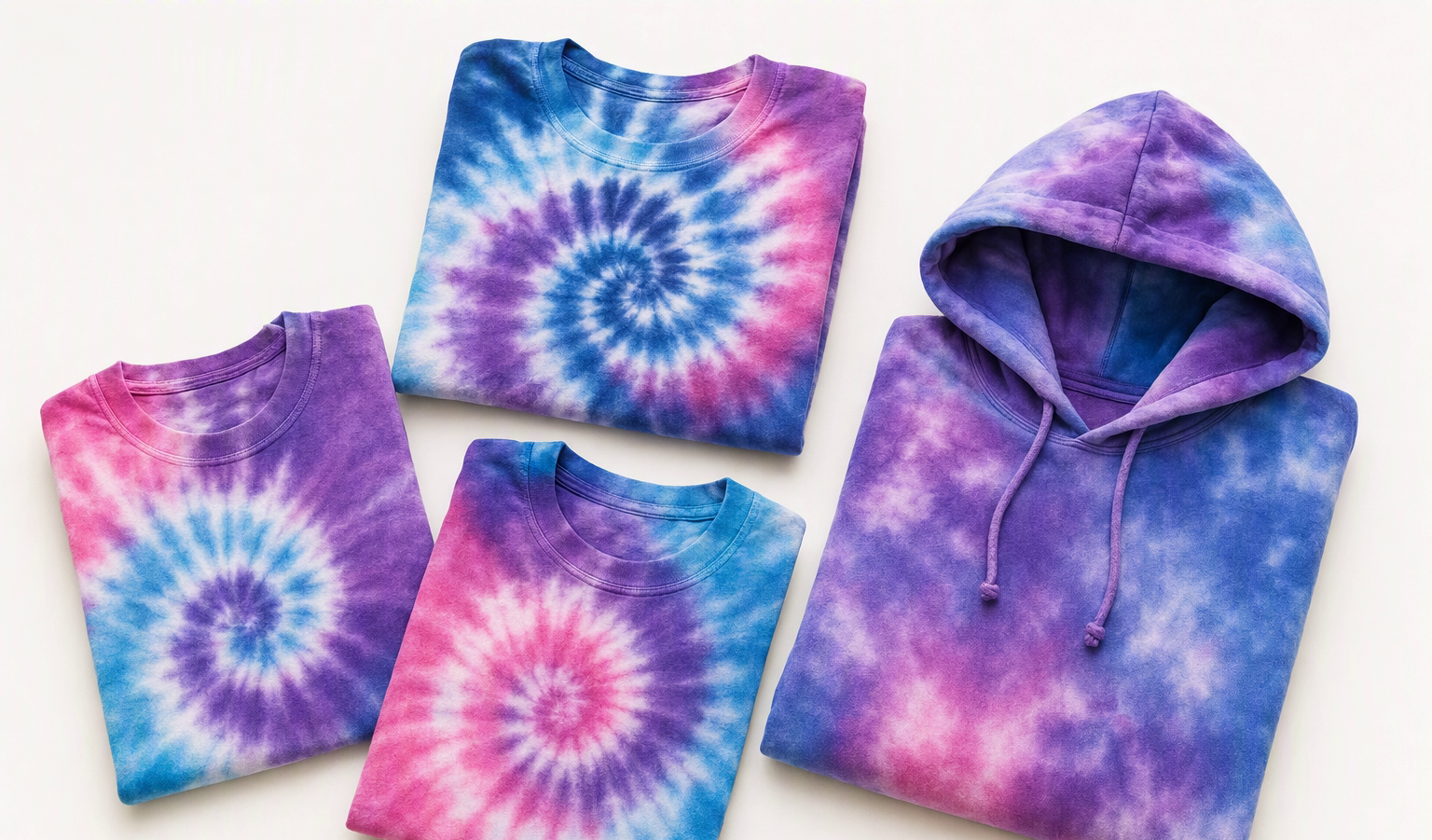
Fexwear is a custom tie dye clothing manufacturer producing tie-dyed t-shirts, hoodies, sweats, socks and loungewear with vibrant, colourfast dyeing – whether you want classic hand-tied spirals, ice-dye effects or a consistent sublimated tie-dye print at scale. With low MOQ, custom colourways and soft cotton bases, we help streetwear, festival, promo and lifestyle brands build tie-dye ranges that pop and stay bright.
This guide covers the two ways to make tie dye, colourfastness, and how to brief a tie-dye range.
How to choose a tie dye clothing manufacturer
A low unit price means little if quality drifts between batches or the supplier disappears when something goes wrong. When you shortlist tie dye clothing suppliers, judge them on control and communication as much as cost:
- Real factory vs middleman – can they show production lines and control the process?
- Fabric knowledge – they should advise on GSM, blend and finish for your use case.
- Sample discipline – a proper pre-production sample before bulk.
- Decoration durability – logos that survive washing; ask how they test.
- Sizing & grading – consistent measurements across the size run.
- Lead-time honesty – realistic dates beat optimistic ones.
A practical test: ask each supplier for a fabric swatch card and a recent sample of comparable tie dye clothing. A real factory produces both quickly and can explain every choice; a reseller stalls or forwards generic photos. Also ask who owns the sewing lines – if the answer is vague, you’re paying a middleman’s margin on top of the risk.
Finally, weigh responsiveness against price. A supplier 5%% cheaper who takes a week to answer will cost you more in missed seasons than a partner who replies the same day. The brands that win treat their manufacturer as part of the team, not a line item.
Where to source: Fexwear vs Alibaba vs local
| Channel | Pros | Cons |
|---|---|---|
| Fexwear (direct factory) | In-house control, low MOQ, free design, direct pricing | Pre-production sampling takes a few days |
| Alibaba / marketplace | Huge choice, low list prices | Variable quality, middlemen, hard to verify, MOQ surprises |
| Local manufacturer | Fast shipping, easy visits | Higher unit cost, limited fabrics & decoration |
The risks of sourcing from Alibaba (and how to avoid them)
- Middlemen posing as factories – many ‘manufacturers’ subcontract, adding cost and cutting you off from the line.
- Inconsistent, uncontrollable quality – it varies between suppliers and even between batches.
- Sample-vs-bulk bait-and-switch – the approved sample looks great, the bulk quietly changes.
- No accountability after payment – chasing fixes or refunds is slow and often fruitless.
- Misrepresented materials & certifications – claims that can’t be backed by certificates.
- MOQ and price surprises – list prices that jump once tooling and labels are added.
Alibaba can work if you verify the factory, insist on a pre-production sample and arrange independent QC – but a direct in-house manufacturer gives you comparable pricing with real production control and accountability on every batch.
Tie dye garments we make
- Tie dye t-shirts & baby tees
- Hoodies & crewneck sweatshirts
- Sweatpants, joggers & shorts
- Socks, caps & accessories
- Loungewear & matching sets
- Tie dye dresses & tanks
Tie dye lives or dies on the base garment and the dye. A heavy cotton fleece takes a bold spiral beautifully; a lightweight tee suits pastel ice-dye. We start from quality, dye-friendly cotton and choose the technique – hand-tie for organic uniqueness, or sublimation for a repeatable tie-dye look at volume – to match your product and price.
2026 trends
- Pastel & muted tie dye over loud neons
- Ice-dye & crumple effects
- Discrete / small-batch hand-tied drops
- Matching sets (hoodie + jogger)
- Sublimated tie-dye for consistency at scale
Construction & spec options
Every tie dye clothing is a set of decisions – pick each, or let us recommend a build for your price point:
| Spec | Options |
|---|---|
| Technique | Hand-tie, ice-dye, or sublimated print |
| Base | Cotton jersey, fleece, rib |
| Colour | Custom colourways & palettes |
| Style | Tee, hoodie, sweats, socks, hat |
| Finish | Pre-shrunk, colourfast, soft-hand |
The make-or-break quality in tie dye is colourfastness – cheap dye bleeds in the wash and fades to dull within weeks. We fix the dye properly and pre-shrink the garment so colours stay vivid and the size holds, which is exactly what separates a premium tie-dye brand from a market-stall one.
Fabrics & GSM
Choose the base for the effect:
| Fabric | Typical weight | Best for |
|---|---|---|
| Combed cotton jersey | 160-220 GSM | Tees & tanks, bright dye uptake |
| Cotton fleece | 280-380 GSM | Hoodies & sweats, bold spirals |
| Rib & stretch knits | 180-240 GSM | Fitted crops & sets |
| Recycled / organic cotton | varies | Sustainable tie dye |
What is GSM and how to choose fabric weight
GSM (grams per square metre) is the fabric’s weight – the biggest driver of how a garment feels. Lower GSM is lighter and cooler; higher GSM is denser, more opaque and more premium. For tie dye clothing, matching the weight to how it’s worn and washed is what separates a product people reorder from one they return.
| GSM range | Feel | Best for |
|---|---|---|
| 120-160 GSM | Very light, breathable | Summer & performance |
| 160-220 GSM | Mid-weight, soft | Everyday & lifestyle |
| 220-300 GSM | Heavy, structured | Premium & streetwear |
| 300+ GSM | Thick, luxe drape | Designer heavyweight |
Heavier cotton bases (fleece, 200+ GSM jersey) hold saturated tie-dye colour best and feel premium; lighter fabrics suit softer pastel effects. We match base weight to the dye effect you’re selling.
Blank vs private-label vs custom vs POD
| Model | What it is | Best for |
|---|---|---|
| Blank wholesale | Unbranded, you print | Fast, low-cost starts |
| Private label | Your fabric, fit & colours to spec | A signature product |
| Custom cut & sew | Developed from scratch | Full control & differentiation |
| Print-on-demand | Per-unit, no stock | Zero-risk testing |
Most brands start with blanks to test demand, then move to private label once a style sells. We support all paths, and many clients run two or three at once across different parts of a catalogue.
Decoration & branding options
| Method | Durability | Best for |
|---|---|---|
| Screen printing | High | Bold logos, bulk, spot colours |
| DTG (digital) | Medium-High | Detailed, multi-colour, small runs |
| Embroidery | Very high | Premium chest & label marks |
| Dye-sublimation | Permanent | All-over polyester performance prints |
| Heat transfer | Medium | Fast, low-cost, small batches |
With tie dye the pattern is the decoration, so branding stays minimal – a small chest logo, a woven hem label or a neck print. We place branding so it reads clearly against the busy pattern rather than getting lost in it.
MOQ, sampling & lead time
We keep MOQs low so you can test before committing. Sampling runs in stages – a proto sample, a fit sample, then a pre-production (PP) sample that locks fabric, colour and decoration. Standard samples turn around in days; bulk typically takes a few weeks once the PP sample is approved. Sample fees are usually credited against your bulk order, so testing costs little beyond the wait.
When planning quantities, order enough of your confident styles to reach the flat part of the price curve, and keep experimental pieces at the minimum. Reordering proven sellers is cheap and fast because the pattern and decoration files already exist – so let demand, not a guess, drive your second order.
What drives the cost
- Fabric & GSM – performance and heavyweight fabrics cost more.
- Quantity – unit price falls as order size grows.
- Decoration – print size, colour count and embroidery complexity.
- Custom trims – woven labels, special elastics and packaging.
- Fit development – multiple sample rounds add time and cost.
- Logistics – destination, Incoterms and shipping method.
The quoted garment price is only part of the real cost. On top of it sits decoration, custom trims, packaging and freight, so always ask for a landed per-unit figure for the fully-branded product rather than comparing bare garment prices. Unit cost also falls with quantity, but not linearly – there’s a steep drop between a tiny test order and a real run, then it flattens, so order enough to reach the flat part for confident styles while keeping unproven ones at low MOQ.
What to send us for an accurate quote
Include: style reference or sketch, target fabric & GSM, size range and measurement chart, colours, logo artwork (vector if possible) and print method, quantity, and target price. No tech pack yet? Send a photo or a competitor example and our design team will build it with you. The more specific your brief, the tighter the price and the shorter the sample turnaround.
A clear brief also protects you: most disputes in apparel sourcing trace back to an ambiguous spec, not a bad factory. Nail the measurements, the colour codes and the decoration method up front and the whole order runs smoother.
Sizing & measurement
Garment-dyeing and washing shrinks cotton, so we pre-shrink and grade with the shrinkage accounted for, and provide a true size chart – because a tie-dye hoodie that shrinks two sizes after one wash is a return and a bad review.
Sizing is a profit lever, not a detail: a garment that runs small or stretches unevenly drives returns, and returns eat margin twice – once in shipping, once in the unsellable unit. The fix is a clear, honest size chart with real garment measurements, consistent grading, and a fit sample checked on a body.
Quality control
Every run is checked at three points – pre-production (approved PP sample and materials), inline (during sewing and printing), and final inspection before packing. We inspect to an AQL standard (commonly 2.5 major / 4.0 minor defects for apparel) and photograph key checkpoints so you can see what we saw. You approve the PP sample, and that sample becomes the standard the whole order is judged against.
Sustainable options
We offer organic and recycled-cotton bases and lower-impact, water-saving dyeing where possible, with OEKO-TEX-certified dyes so bright colours don’t come at a harmful-chemical cost. Ask for the certificates to back a responsible tie-dye story.
If sustainability matters to your buyer, decide early: recycled-polyester and organic-cotton options are the easiest wins and both can be certified. The key is paperwork – a GOTS or GRS scope certificate plus a transaction certificate for your specific order – because that’s what lets you legally and credibly put the claim on your hangtag.
Common mistakes to avoid
- Dye that bleeds or fades after a few washes
- No pre-shrinking, so garment-dyed pieces shrink
- Inconsistent hand-tied patterns when a uniform look was wanted
- Cheap cotton that takes dye poorly
- Branding that disappears into the pattern
The most common thread behind all of these is skipping the sample or over-ordering an unproven style. Test broadly with small quantities, watch what actually sells, then concentrate your budget on the winners – suppliers who push you to commit to volume before you have sales data are optimising for their schedule, not your cash flow.
Who we manufacture for
- Streetwear & festival brands
- Promo, events & merch
- Music & sports teams
- Lifestyle & loungewear labels
- Online & DTC sellers
- Schools & camps
A festival brand wants bold hand-tied spirals in small drops; a promo buyer wants a consistent tie-dye look across 300 units; a loungewear label wants muted pastels in matching sets. We match the technique – hand-tie vs sublimation – and the base fabric to each brief.
Why brands choose Fexwear
- Vibrant, colourfast, fixed dye
- Pre-shrunk, soft premium cotton bases
- Hand-tie or sublimated, per your need
- Low MOQ for small drops
- Custom colourways & minimal branding
The short version: you get factory-direct economics with the guidance of a partner who has made the mistakes so you don’t have to. We’ll tell you when a fabric will pill, when a print method is wrong for the garment, and when an order size is unrealistic – and we’ll still make it happen when you’re right.
Order timeline: enquiry to delivery
| Stage | Typical time |
|---|---|
| Enquiry & quote | 1-2 days |
| Proto / fit sample | 3-7 days |
| PP sample approval | 3-5 days |
| Bulk production | 2-4 weeks |
| QC & packing | 3-5 days |
| Shipping (air/sea) | 3-30 days by method |
Working to a launch date or a seasonal drop? Tell us the deadline up front and we’ll build the schedule backwards from it so you’re not air-freighting in a panic.
How to start
- Share garment, colours & technique
- We dye a sample for approval
- Confirm colourfastness & sizing
- Bulk production, QC & worldwide shipping
Hand-tie vs sublimated tie dye: choosing the right method
There are two ways to make tie dye, and they suit different businesses. Hand-tie dyeing is done on the finished garment by tying and dyeing by hand, giving each piece a unique, organic pattern – perfect for premium, small-batch drops where no two are alike, but inconsistent by nature and slower. Sublimation prints a tie-dye design onto fabric before cutting, giving a perfectly repeatable pattern at volume – ideal when a promo or team order needs 300 identical shirts. The right choice depends on whether you’re selling the artistry of one-of-a-kind or the reliability of a consistent look, and we’ll recommend per order.
Colourfastness: the quality that defines tie dye
Tie dye has a reputation for bleeding and fading, and cheap producers do nothing to fix it. The difference between a premium tie-dye brand and a disposable one is dye chemistry and finishing – proper fixing so colours survive washing, and pre-shrinking so garment-dyed pieces keep their size. We test colourfastness and shrinkage on the sample before you approve bulk, because in this category the first wash is where a brand is either proven or ruined.
Request a quote
Tell us your tie dye clothing, fabric and quantity and we’ll come back with pricing, MOQ and a timeline. Related: custom tank tops, white label and contact Fexwear →
Designing a tie dye colourway
Great tie dye starts with a deliberate palette, not a random splash of colours. The best ranges pick two or three colours that blend well where they meet – analogous shades melt, complementary ones create muddy browns at the overlap – and set a base (undyed cream, black, or a light cotton) that makes the dye pop. We help you build a colourway system so every piece in a drop feels related, and lock the recipe so a reorder matches the original.
Consistency vs one-of-a-kind
Tie dye has a tension at its heart: buyers love that hand-tied pieces are unique, but a brand selling a specific look needs some consistency. The resolution is to control the variables – the same base garment, the same dye colours, the same technique – so every piece is recognisably the same design while each one varies slightly. For promo or team orders that need identical shirts, sublimated tie dye gives perfect consistency. We’ll match the method to how you sell.
Sizing and shrinkage in garment-dyed pieces
Because tie dye is usually dyed after the garment is sewn, the whole piece goes through hot water and agitation – which shrinks cotton. A tie-dye hoodie that shrinks two sizes in the customer’s first wash is a guaranteed return. We pre-shrink during the dyeing process and grade with that shrinkage accounted for, then publish a true size chart, so the garment the customer buys is the size that comes back out of their machine.
The festival, merch and gifting angle
Tie dye sells hard in specific moments – festivals, summer events, team and camp merch, and one-off drops where the uniqueness is the point. It’s also a strong low-commitment product because small hand-tied batches feel exclusive and command a premium. We help you plan drops around these moments and keep MOQ low enough to test a colourway before committing to volume.
Care and keeping tie dye bright
Even colourfast tie dye benefits from good care, and educating customers protects your brand’s reputation. Cold wash, wash separately the first time, and avoid harsh bleach keep colours vivid far longer. We fix the dye properly and provide simple care guidance, so a tie-dye tee the customer loves on day one is still bright a year later – which is what earns the reorder and the recommendation.
Choosing the base garment
Tie dye is only as good as the blank it’s applied to. A heavy, combed-cotton tee takes saturated colour and holds its shape; a thin, blended-cotton tee goes muddy and misshapen in the dye bath. Because the garment is dyed after sewing, its quality and shrink behaviour set the ceiling for the whole product. We start from premium, dye-friendly cotton bases so the finished tie dye feels as good as it looks, rather than a cheap blank dressed up in bright colour.
Two-tone vs multi-colour effects
The palette complexity changes both the look and the process. A two-tone spiral is bold, cheap and fast; a multi-colour or pastel ice-dye effect is softer, more premium and more labour-intensive. Choosing where your range sits on that spectrum is a positioning decision – a promo run favours punchy two-tone, a boutique drop favours nuanced multi-colour. We’ll match technique and cost to the market you’re selling into.
MOQ economics for tie dye
Hand-tie dyeing is labour-driven, so each additional colour and technique adds cost, while sublimated tie dye spreads set-up over volume. The practical result: small hand-tied drops carry a higher unit price (justified by their one-of-a-kind nature), while a consistent sublimated look gets much cheaper at volume. We help you choose the method that fits your order size and price point rather than forcing one approach.
Presenting tie dye online
Tie dye sells on colour and personality, so photography and copy carry the sale. Show the actual pattern variety (especially for hand-tied, where each piece differs), shoot on bodies so buyers see how the dye sits on a worn garment, and be honest that hand-tied pieces vary. Setting that expectation turns the uniqueness from a complaint risk into the selling point – and it’s what makes a tie-dye brand feel authentic rather than a lottery.
Colourfastness is the brand
In tie dye, the first wash decides whether a customer trusts you. Colours that bleed onto other clothes or fade to dull pastels get one-star reviews and no reorders, no matter how good the design looked. That’s why we treat dye fixing and colourfastness testing as the core quality gate, not an afterthought – a tie-dye brand’s reputation is built on colours that stay as vivid in month six as on day one.
Glossary
| Term | Meaning |
|---|---|
| GSM | Grams per square metre – fabric weight |
| Tech pack | Spec sheet with measurements, fabrics & artwork |
| Proto / fit / PP sample | Prototype, fit-check and pre-production samples |
| Sublimation | All-over dye print fused into polyester |
| Serging / overlock | Seam finishing that prevents fraying |
| AQL | Acceptable Quality Level – inspection standard |
| Incoterms | Shipping terms like FOB, EXW, DDP |
| Cut & sew | Fully custom from fabric roll, not printing blanks |
Frequently Asked Questions
What tie dye garments can you make?
T-shirts, hoodies, crewnecks, sweats, socks, caps, dresses and matching loungewear sets.
Hand-tied or printed tie dye?
Both – hand-tie for unique, small-batch pieces; sublimated print for a consistent look at volume.
Will the colours fade or bleed?
We fix the dye and test colourfastness so colours stay vivid and don't bleed, wash after wash.
What's the MOQ for tie dye?
Low MOQ, so small drops and promo runs are both easy.
Can you match specific colours?
Yes – we dye to your custom colourways and palettes.
Do you pre-shrink garment-dyed pieces?
Yes – we pre-shrink so the size holds after the first wash.
Are sustainable tie-dye options available?
Yes – organic/recycled cotton bases and OEKO-TEX-certified dyes.