
Custom Denim & Jeans Manufacturer
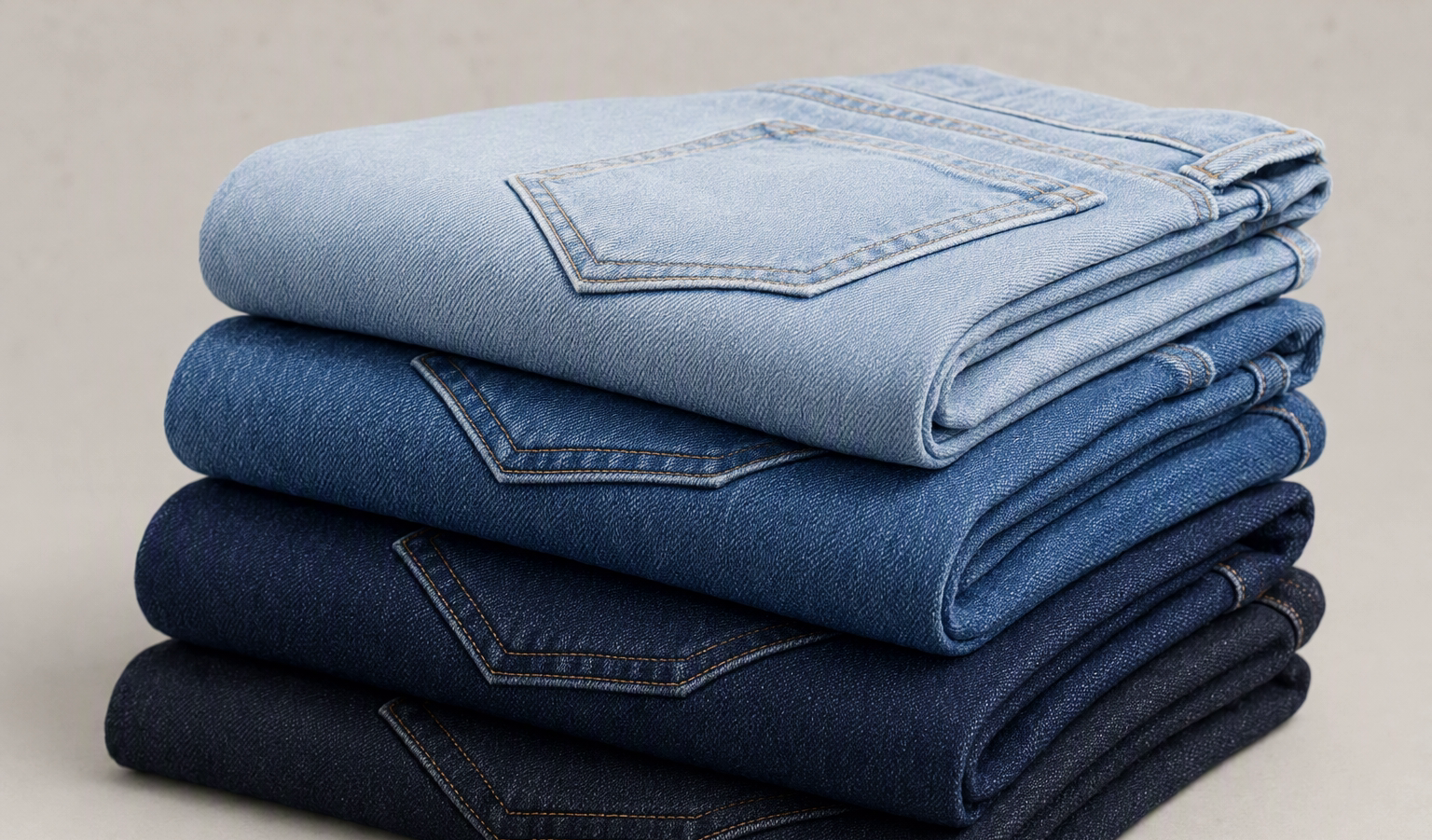
Fexwear is a custom denim and jeans manufacturer producing jeans, jackets, skirts and shorts in real denim – from rigid selvedge-style to stretch comfort denim – with the washes, hardware and stitching that define a denim brand. With low MOQ, custom fits and wash development, we help denim and streetwear labels build jeans people actually want to wear in.
This guide covers denim weights and washes, fit and hardware, and how to brief a denim range.
How to choose a custom denim & jeans manufacturer
A low unit price means little if quality drifts between batches or the supplier disappears when something goes wrong. When you shortlist custom denim & jeans suppliers, judge them on control and communication as much as cost:
- Real factory vs middleman – can they show production lines and control the process?
- Fabric knowledge – they should advise on GSM, blend and finish for your use case.
- Sample discipline – a proper pre-production sample before bulk.
- Decoration durability – logos that survive washing; ask how they test.
- Sizing & grading – consistent measurements across the size run.
- Lead-time honesty – realistic dates beat optimistic ones.
A practical test: ask each supplier for a fabric swatch card and a recent sample of comparable custom denim & jeans. A real factory produces both quickly and can explain every choice; a reseller stalls or forwards generic photos. Also ask who owns the sewing lines – if the answer is vague, you’re paying a middleman’s margin on top of the risk.
Finally, weigh responsiveness against price. A supplier 5%% cheaper who takes a week to answer will cost you more in missed seasons than a partner who replies the same day. The brands that win treat their manufacturer as part of the team, not a line item.
Where to source: Fexwear vs Alibaba vs local
| Channel | Pros | Cons |
|---|---|---|
| Fexwear (direct factory) | In-house control, low MOQ, free design, direct pricing | Pre-production sampling takes a few days |
| Alibaba / marketplace | Huge choice, low list prices | Variable quality, middlemen, hard to verify, MOQ surprises |
| Local manufacturer | Fast shipping, easy visits | Higher unit cost, limited fabrics & decoration |
The risks of sourcing from Alibaba (and how to avoid them)
- Middlemen posing as factories – many ‘manufacturers’ subcontract, adding cost and cutting you off from the line.
- Inconsistent, uncontrollable quality – it varies between suppliers and even between batches.
- Sample-vs-bulk bait-and-switch – the approved sample looks great, the bulk quietly changes.
- No accountability after payment – chasing fixes or refunds is slow and often fruitless.
- Misrepresented materials & certifications – claims that can’t be backed by certificates.
- MOQ and price surprises – list prices that jump once tooling and labels are added.
Alibaba can work if you verify the factory, insist on a pre-production sample and arrange independent QC – but a direct in-house manufacturer gives you comparable pricing with real production control and accountability on every batch.
Denim garments we make
- Straight, slim & skinny jeans
- Wide-leg & baggy jeans
- Mom, boyfriend & flare cuts
- Denim jackets & trucker styles
- Denim skirts & shorts
- High-waist & stretch comfort denim
Denim is a fit-and-wash category. The same cut in a different weight or wash reads completely differently – a rigid 12-13oz straight leg is a heritage piece, a stretch skinny is everyday comfort, a wide-leg in mid-weight is the current fashion. We build on proper denim blocks and develop the wash to match the silhouette you’re selling.
2026 trends
- Wide-leg & baggy replacing skinny
- Mid-weight comfort denim with stretch
- Vintage & enzyme washes, whiskering
- Ecru / rigid & raw denim
- Recycled-cotton & low-impact washes
Construction & spec options
Every custom denim & jeans is a set of decisions – pick each, or let us recommend a build for your price point:
| Spec | Options |
|---|---|
| Fit | Straight, slim, wide, mom, flare, boyfriend |
| Weight | 10-14 oz denim (rigid to stretch) |
| Wash | Raw, stone, enzyme, acid, vintage, bleach |
| Hardware | Rivets, shank buttons, zip, D-ring |
| Fabric | 100% cotton, cotton-elastane, T400 stretch |
Denim quality lives in the details: the weight and hand of the fabric, the strength of the indigo and its fade behaviour, the quality of rivets and buttons, and the wash process. A cheap wash that doesn’t sit right or hardware that rusts is instantly obvious. We spec all of it deliberately.
Fabrics & GSM
Choose the denim for the fit and feel:
| Fabric | Typical weight | Best for |
|---|---|---|
| 100% cotton rigid | 11-14 oz | Heritage, structured, fades well |
| Cotton-elastane stretch | 10-12 oz | Comfort, fitted silhouettes |
| T400 / eco-stretch | 10-13 oz | Recovery without spandex |
| Recycled-cotton denim | 11-13 oz | Sustainable denim story |
What is GSM and how to choose fabric weight
GSM (grams per square metre) is the fabric’s weight – the biggest driver of how a garment feels. Lower GSM is lighter and cooler; higher GSM is denser, more opaque and more premium. For custom denim & jeans, matching the weight to how it’s worn and washed is what separates a product people reorder from one they return.
| GSM range | Feel | Best for |
|---|---|---|
| 120-160 GSM | Very light, breathable | Summer & performance |
| 160-220 GSM | Mid-weight, soft | Everyday & lifestyle |
| 220-300 GSM | Heavy, structured | Premium & streetwear |
| 300+ GSM | Thick, luxe drape | Designer heavyweight |
Denim is measured in ounces, not GSM: 10-12 oz is mid-weight and versatile, 13-14+ oz is heavy and rigid for heritage looks. Weight drives drape, fade and durability, so we match it to the fit you’re selling.
Blank vs private-label vs custom vs POD
| Model | What it is | Best for |
|---|---|---|
| Blank wholesale | Unbranded, you print | Fast, low-cost starts |
| Private label | Your fabric, fit & colours to spec | A signature product |
| Custom cut & sew | Developed from scratch | Full control & differentiation |
| Print-on-demand | Per-unit, no stock | Zero-risk testing |
Most brands start with blanks to test demand, then move to private label once a style sells. We support all paths, and many clients run two or three at once across different parts of a catalogue.
Decoration & branding options
| Method | Durability | Best for |
|---|---|---|
| Screen printing | High | Bold logos, bulk, spot colours |
| DTG (digital) | Medium-High | Detailed, multi-colour, small runs |
| Embroidery | Very high | Premium chest & label marks |
| Dye-sublimation | Permanent | All-over polyester performance prints |
| Heat transfer | Medium | Fast, low-cost, small batches |
On denim, branding is often in the hardware and stitching – custom shank buttons, rivets, a woven patch on the back waistband, contrast topstitch and a branded leather patch. These small, tactile details signal a real denim brand more than a big logo.
MOQ, sampling & lead time
We keep MOQs low so you can test before committing. Sampling runs in stages – a proto sample, a fit sample, then a pre-production (PP) sample that locks fabric, colour and decoration. Standard samples turn around in days; bulk typically takes a few weeks once the PP sample is approved. Sample fees are usually credited against your bulk order, so testing costs little beyond the wait.
When planning quantities, order enough of your confident styles to reach the flat part of the price curve, and keep experimental pieces at the minimum. Reordering proven sellers is cheap and fast because the pattern and decoration files already exist – so let demand, not a guess, drive your second order.
What drives the cost
- Fabric & GSM – performance and heavyweight fabrics cost more.
- Quantity – unit price falls as order size grows.
- Decoration – print size, colour count and embroidery complexity.
- Custom trims – woven labels, special elastics and packaging.
- Fit development – multiple sample rounds add time and cost.
- Logistics – destination, Incoterms and shipping method.
The quoted garment price is only part of the real cost. On top of it sits decoration, custom trims, packaging and freight, so always ask for a landed per-unit figure for the fully-branded product rather than comparing bare garment prices. Unit cost also falls with quantity, but not linearly – there’s a steep drop between a tiny test order and a real run, then it flattens, so order enough to reach the flat part for confident styles while keeping unproven ones at low MOQ.
What to send us for an accurate quote
Include: style reference or sketch, target fabric & GSM, size range and measurement chart, colours, logo artwork (vector if possible) and print method, quantity, and target price. No tech pack yet? Send a photo or a competitor example and our design team will build it with you. The more specific your brief, the tighter the price and the shorter the sample turnaround.
A clear brief also protects you: most disputes in apparel sourcing trace back to an ambiguous spec, not a bad factory. Nail the measurements, the colour codes and the decoration method up front and the whole order runs smoother.
Sizing & measurement
Denim fit is exact – waist, rise, thigh and inseam all matter, and stretch changes the fit. We build on denim blocks, fit on a model, and provide waist/inseam sizing so customers order the right pair first time.
Sizing is a profit lever, not a detail: a garment that runs small or stretches unevenly drives returns, and returns eat margin twice – once in shipping, once in the unsellable unit. The fix is a clear, honest size chart with real garment measurements, consistent grading, and a fit sample checked on a body.
Quality control
Every run is checked at three points – pre-production (approved PP sample and materials), inline (during sewing and printing), and final inspection before packing. We inspect to an AQL standard (commonly 2.5 major / 4.0 minor defects for apparel) and photograph key checkpoints so you can see what we saw. You approve the PP sample, and that sample becomes the standard the whole order is judged against.
Sustainable options
Low-impact and recycled denim options exist – recycled-cotton blends, water-saving washes (laser, ozone, enzyme) and T400 stretch. Denim washing is water-intensive, so choosing responsible wash processes is a genuine sustainability lever.
If sustainability matters to your buyer, decide early: recycled-polyester and organic-cotton options are the easiest wins and both can be certified. The key is paperwork – a GOTS or GRS scope certificate plus a transaction certificate for your specific order – because that’s what lets you legally and credibly put the claim on your hangtag.
Common mistakes to avoid
- Ignoring shrink – denim shrinks and must be pre-washed or sized for it
- Cheap hardware that rusts or breaks
- A wash that doesn’t suit the fit
- No stretch-recovery so jeans bag out
- Getting rise and inseam wrong for the target market
The most common thread behind all of these is skipping the sample or over-ordering an unproven style. Test broadly with small quantities, watch what actually sells, then concentrate your budget on the winners – suppliers who push you to commit to volume before you have sales data are optimising for their schedule, not your cash flow.
Who we manufacture for
- Denim & streetwear brands
- Fashion labels adding denim
- Boutiques & DTC sellers
- Workwear & utility brands
- Sustainable denim startups
A heritage label wants rigid selvedge-style with copper rivets; a fast-fashion brand wants stretch skinny in volume; a sustainable startup wants recycled cotton and water-saving washes. Denim is a specialist craft and we set weight, wash and hardware to each brief.
Why brands choose Fexwear
- Real denim construction & wash development
- Custom fit, hardware & stitching
- Low MOQ for emerging denim brands
- Water-saving & recycled options
- Durable fabrics that fade well
The short version: you get factory-direct economics with the guidance of a partner who has made the mistakes so you don’t have to. We’ll tell you when a fabric will pill, when a print method is wrong for the garment, and when an order size is unrealistic – and we’ll still make it happen when you’re right.
Order timeline: enquiry to delivery
| Stage | Typical time |
|---|---|
| Enquiry & quote | 1-2 days |
| Proto / fit sample | 3-7 days |
| PP sample approval | 3-5 days |
| Bulk production | 2-4 weeks |
| QC & packing | 3-5 days |
| Shipping (air/sea) | 3-30 days by method |
Working to a launch date or a seasonal drop? Tell us the deadline up front and we’ll build the schedule backwards from it so you’re not air-freighting in a panic.
How to start
- Share fit, weight & wash direction
- Develop fabric, hardware & a wash sample
- Approve fit & wash on a sample
- Bulk production, QC & worldwide shipping
Why denim is a wash-and-fade category
What makes denim denim is how it ages. The indigo sits on the surface of the yarn, so it fades at the knees, seat and pockets to create a wear pattern that’s personal to the wearer – and a good pair gets better with time. That only happens with the right fabric, dye and construction; cheap denim either doesn’t fade well or falls apart first. We build for that ageing behaviour, choosing weight, indigo and stitch so your jeans look better at a year than on day one, which is exactly what denim customers value.
Washes, water and the sustainability lever
Denim’s dirtiest secret is washing – conventional stone and bleach washes consume enormous water and chemicals. The industry’s answer is laser, ozone and enzyme processing that achieve the same vintage look with a fraction of the water. If sustainability matters to your denim brand, the wash process is where to focus, not just the fibre. We offer these lower-impact wash techniques and can document the water savings behind your claims.
Request a quote
Tell us your custom denim & jeans, fabric and quantity and we’ll come back with pricing, MOQ and a timeline. Related: custom tank tops, white label and contact Fexwear →
Fit blocks: rise, thigh and inseam
Jeans fit is defined by four numbers – rise (front and back), thigh, knee and inseam – and getting them right for your target market is the whole game. A high-rise straight leg and a low-rise skinny are different patterns, not the same pattern graded. We build on denim blocks matched to the silhouette you’re selling and fit on a model, because a jean that fits through the waist but pulls at the thigh is a return, no matter how good the wash looks.
Hardware and stitching that signal quality
Denim buyers judge quality through the hand: the weight of the shank buttons, the feel of the rivets, the evenness of the topstitch, the strength of the zipper. Cheap plastic hardware and puckered stitching read as ‘fast fashion’ instantly and undermine a premium price. We spec metal hardware, reinforced stress points and clean, consistent stitching so the jeans feel considered in a way that justifies the brand.
Wash development and shrink control
The wash is where denim’s character comes from – and where it can go wrong. A wash must be developed on the actual fabric, colourfast, and controlled for shrink so a size 30 stays a 30. We develop wash samples on your fabric, test shrink and colourfastness, and lock the recipe so every batch matches. A beautiful wash that fades unevenly or shrinks two sizes is the fastest way to lose a denim customer.
Building a denim range and sizing
A denim collection lives on a consistent fit story – one hero straight, one slim, one wide, each in a small colour and wash edit – rather than a scatter of cuts. That focus lowers inventory risk, makes your size curve manageable, and lets customers learn and trust your fit. We help you plan the range and hold the blocks and wash recipes so reorders and new colours stay true to the original.
Sustainability in denim
Denim is one of the most resource-intensive fabrics to make, so the sustainability levers are significant: recycled cotton, organic cotton, T400 eco-stretch instead of degrading spandex, and above all water-saving washes like laser, ozone and enzyme that replace the water-heavy stone and bleach processes. Because the wash is where denim’s footprint concentrates, choosing responsible wash techniques is often a bigger win than the fibre alone. We can supply these options with documentation to back your claims.
Fit sampling on real bodies
A jean that looks perfect flat can pinch, gap at the back waist or bag at the knee on a body. That’s why we fit-sample on a model before bulk – checking rise, thigh, seat and how the stretch recovers – rather than trusting a flat measurement. One fit round on a body catches the problems that would otherwise ship to thousands of customers and come back as returns.
Pricing and the landed cost of jeans
Jeans carry more cost components than most garments – fabric weight, wash processing, hardware, and rivet/button setting – so a headline price hides a lot. Build your retail from the landed cost including the wash, hardware and freight, and remember that a better wash and hardware are what let you charge a premium. We’ll show you where the money goes so you can price on value, not just cost.
Building a denim size curve
Denim sizing is waist-and-inseam based, and getting the curve right for your market matters – stocking the wrong length or missing sizes loses sales. We grade across a clear waist/inseam grid, hold the fit consistent across washes, and provide a size chart so customers order the right pair. A reliable, well-stocked size curve is a big part of why denim customers return.
Denim quality checks before bulk
Before approving a bulk run, check the denim specifics: pull a seam to test strength, stretch the fabric to check recovery, wash a swatch to verify shrink and colourfastness, and inspect hardware attachment and topstitching evenness. These take minutes on a sample and protect an entire order. We build these checkpoints into every denim pre-production sample so nothing expensive ships on a hope.
Building a denim brand story
Denim is a heritage, story-driven category – customers buy the fit, the wash and the provenance as much as the cloth. A clear story (the weight, the wash technique, the hardware, the origin of the denim) lets you command a premium and build a loyal following. We help you spec details worth talking about and document them, so your brand has a real narrative rather than just another pair of jeans.
Sizing and colour consistency across reorders
Denim customers buy the same size repeatedly, so the moment your size 30 runs small or your medium-wash shifts colour, you lose trust fast. That consistency comes from holding the pattern blocks, the wash recipe and the fabric spec on file and re-producing to exactly the same standard each time. We keep those records so a pair bought next season fits and fades like the last – which is the single biggest driver of loyalty in a denim brand.
Glossary
| Term | Meaning |
|---|---|
| GSM | Grams per square metre – fabric weight |
| Tech pack | Spec sheet with measurements, fabrics & artwork |
| Proto / fit / PP sample | Prototype, fit-check and pre-production samples |
| Sublimation | All-over dye print fused into polyester |
| Serging / overlock | Seam finishing that prevents fraying |
| AQL | Acceptable Quality Level – inspection standard |
| Incoterms | Shipping terms like FOB, EXW, DDP |
| Cut & sew | Fully custom from fabric roll, not printing blanks |
Frequently Asked Questions
What denim can you manufacture?
Jeans in straight, slim, wide, mom and flare fits, plus denim jackets, skirts and shorts.
Can you do custom washes?
Yes – raw, stone, enzyme, acid, vintage and bleach, including laser and ozone low-water washes.
What denim weight should I choose?
10-12 oz for versatile mid-weight, 13-14+ oz for heavy rigid heritage denim.
Do you offer stretch denim?
Yes – cotton-elastane and T400 eco-stretch for comfort with recovery.
What's the MOQ for custom jeans?
Low MOQ for emerging brands; larger runs improve unit price.
Can you add custom hardware and patches?
Yes – shank buttons, rivets, woven patches and leather waistband labels.
Is sustainable denim available?
Yes – recycled cotton and water-saving wash processes with documentation.