
Custom Hat Manufacturer – Caps, Bucket Hats & Beanies
Fexwear is a custom hat manufacturer producing baseball caps, trucker caps, bucket hats, beanies, dad hats and snapbacks – embroidered, printed or woven-labeled with your brand. With low MOQ, custom colours, structured or unstructured crowns and direct factory pricing, we make it easy for streetwear labels, teams, brands and promo buyers to build headwear that actually sells.
This guide covers the hat styles and constructions available, how branding works on a cap, and what to send us for an accurate quote.
How to choose a custom hat manufacturer
A low unit price means little if quality drifts between batches or the supplier disappears when something goes wrong. When you shortlist custom hat suppliers, judge them on control and communication as much as cost:
- Real factory vs middleman – can they show production lines and control the process?
- Fabric knowledge – they should advise on GSM, blend and finish for your use case.
- Sample discipline – a proper pre-production sample before bulk.
- Decoration durability – logos that survive washing; ask how they test.
- Sizing & grading – consistent measurements across the size run.
- Lead-time honesty – realistic dates beat optimistic ones.
A practical test: ask each supplier for a fabric swatch card and a recent sample of comparable custom hat. A real factory produces both quickly and can explain every choice; a reseller stalls or forwards generic photos. Also ask who owns the sewing lines – if the answer is vague, you’re paying a middleman’s margin on top of the risk.
Finally, weigh responsiveness against price. A supplier 5% cheaper who takes a week to answer will cost you more in missed seasons than a partner who replies the same day. The brands that win treat their manufacturer as part of the team, not a line item.
Where to source: Fexwear vs Alibaba vs local
| Channel | Pros | Cons |
|---|---|---|
| Fexwear (direct factory) | In-house control, low MOQ, free design, direct pricing | Pre-production sampling takes a few days |
| Alibaba / marketplace | Huge choice, low list prices | Variable quality, middlemen, hard to verify, MOQ surprises |
| Local manufacturer | Fast shipping, easy visits | Higher unit cost, limited fabrics & decoration |
The risks of sourcing from Alibaba (and how to avoid them)
- Middlemen posing as factories – many ‘manufacturers’ subcontract, adding cost and cutting you off from the line.
- Inconsistent, uncontrollable quality – it varies between suppliers and even between batches.
- Sample-vs-bulk bait-and-switch – the approved sample looks great, the bulk quietly changes.
- No accountability after payment – chasing fixes or refunds is slow and often fruitless.
- Misrepresented materials & certifications – claims that can’t be backed by certificates.
- MOQ and price surprises – list prices that jump once tooling and labels are added.
Alibaba can work if you verify the factory, insist on a pre-production sample and arrange independent QC – but a direct in-house manufacturer gives you comparable pricing with real production control and accountability on every batch.
Hat styles we manufacture
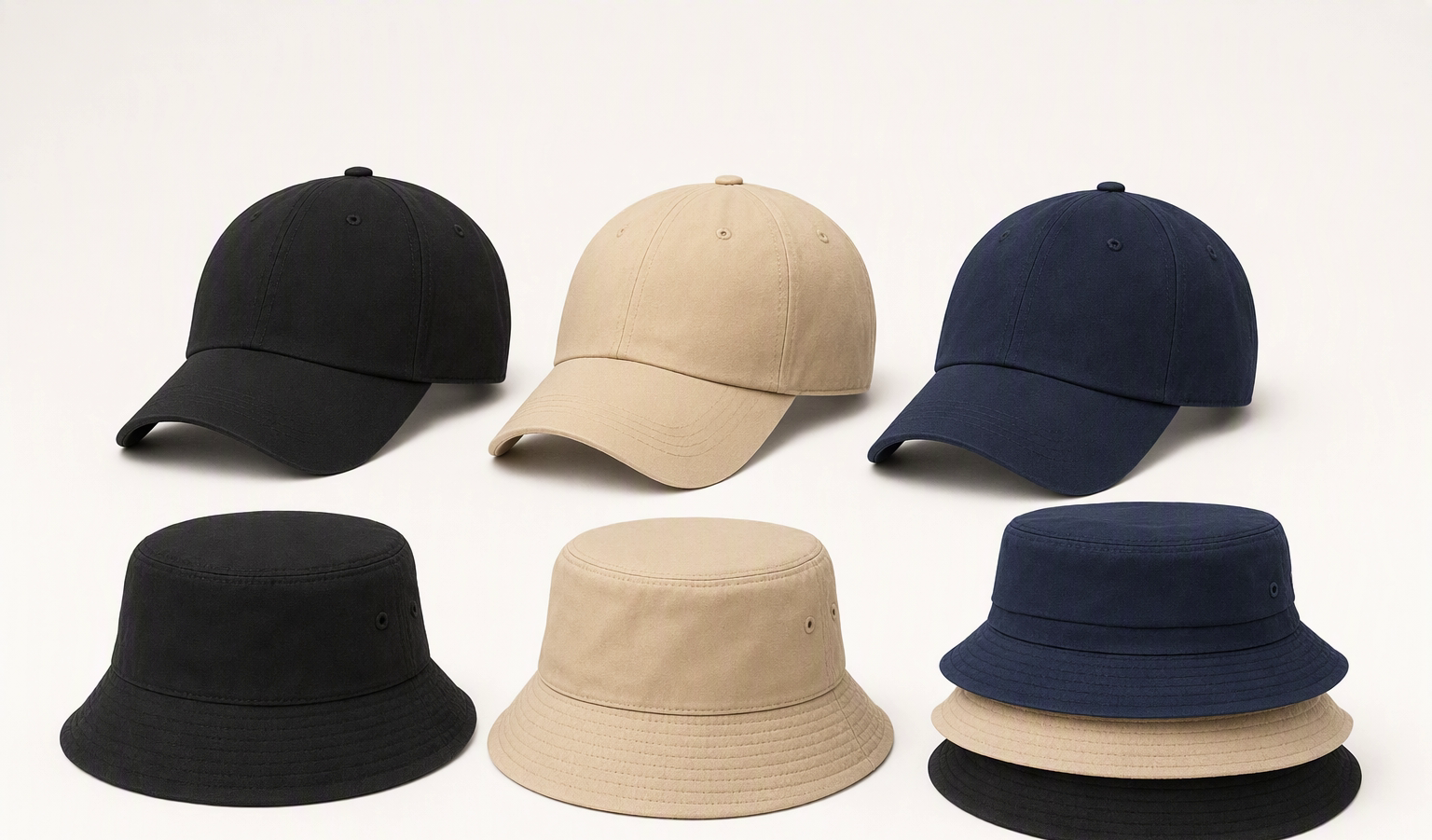
- Baseball & dad hats (6-panel)
- Trucker & mesh-back caps
- Bucket hats
- Beanies & cuffed knit hats
- Snapbacks & fitted caps
- Camp & 5-panel caps
Each construction gives a different look and cost. A structured 6-panel holds a crisp shape; an unstructured dad hat gives a soft, vintage drape; a trucker’s mesh front breathes; a bucket hat’s brim and panel count change its silhouette. Tell us the vibe you’re after and we’ll match the block, the crown height and the brim.
2026 trends
- Unstructured, low-profile dad hats in washed cotton
- Earth-tone & garment-dyed colours
- 3D puff embroidery for premium streetwear
- Recycled-polyester & organic-cotton options
- Vintage & workwear silhouettes
Construction & spec options
Every custom hat is a set of decisions – pick each, or let us recommend a build for your price point:
| Spec | Options |
|---|---|
| Style | 6-panel, 5-panel, trucker, bucket, beanie |
| Crown | Structured / unstructured / mid-profile |
| Closure | Snapback, strap, buckle, elastic, fitted |
| Brim | Curved, flat, pre-curved |
| Fabric | Cotton twill, canvas, corduroy, mesh, acrylic knit |
The small details define a cap: the button and eyelets (metal vs matching thread), the buckram (front-panel stiffness), the sweatband, and the stitching rows on the brim. We spec these deliberately so your hat feels premium in the hand, not just in the photo.
Fabrics & GSM
Choose the fabric for the look and season:
| Fabric | Typical weight | Best for |
|---|---|---|
| Cotton twill / canvas | mid-heavy | Classic structured & dad hats |
| Corduroy / washed cotton | varies | Vintage & streetwear |
| Mesh + foam front (trucker) | light | Breathable summer caps |
| Acrylic / merino knit (beanie) | varies | Cold-weather knits |
What is GSM and how to choose fabric weight
GSM (grams per square metre) is the fabric’s weight – the biggest driver of how a garment feels. Lower GSM is lighter and cooler; higher GSM is denser, more opaque and more premium. For custom hat, matching the weight to how it’s worn and washed is what separates a product people reorder from one they return.
| GSM range | Feel | Best for |
|---|---|---|
| 120-160 GSM | Very light, breathable | Summer & performance |
| 160-220 GSM | Mid-weight, soft | Everyday & lifestyle |
| 220-300 GSM | Heavy, structured | Premium & streetwear |
| 300+ GSM | Thick, luxe drape | Designer heavyweight |
For caps, fabric weight and the front buckram together decide structure – a heavy twill with good buckram holds shape; a light unstructured panel gives the soft vintage look. Neither is ‘better’; it’s about the aesthetic you’re selling.
Blank vs private-label vs custom vs POD
| Model | What it is | Best for |
|---|---|---|
| Blank wholesale | Unbranded, you print | Fast, low-cost starts |
| Private label | Your fabric, fit & colours to spec | A signature product |
| Custom cut & sew | Developed from scratch | Full control & differentiation |
| Print-on-demand | Per-unit, no stock | Zero-risk testing |
Most brands start with blanks to test demand, then move to private label once a style sells. We support all paths, and many clients run two or three at once across different parts of a catalogue.
Decoration & branding options
| Method | Durability | Best for |
|---|---|---|
| Screen printing | High | Bold logos, bulk, spot colours |
| DTG (digital) | Medium-High | Detailed, multi-colour, small runs |
| Embroidery | Very high | Premium chest & label marks |
| Dye-sublimation | Permanent | All-over polyester performance prints |
| Heat transfer | Medium | Fast, low-cost, small batches |
Embroidery is the hat standard – flat for crisp logos, 3D puff for raised streetwear. Woven labels on the side seam, leather patches on the back, and screen-printed linings add the details that make a cap feel branded rather than blank.
MOQ, sampling & lead time
We keep MOQs low so you can test before committing. Sampling runs in stages – a proto sample, a fit sample, then a pre-production (PP) sample that locks fabric, colour and decoration. Standard samples turn around in days; bulk typically takes a few weeks once the PP sample is approved. Sample fees are usually credited against your bulk order, so testing costs little beyond the wait.
What drives the cost
- Fabric & GSM – performance and heavyweight fabrics cost more.
- Quantity – unit price falls as order size grows.
- Decoration – print size, colour count and embroidery complexity.
- Custom trims – woven labels, special elastics and packaging.
- Fit development – multiple sample rounds add time and cost.
- Logistics – destination, Incoterms and shipping method.
The quoted garment price is only part of the real cost. On top of it sits decoration, custom trims, packaging and freight, so always ask for a landed per-unit figure for the fully-branded product rather than comparing bare garment prices. Unit cost also falls with quantity, but not linearly – there’s a steep drop between a tiny test order and a real run, then it flattens, so order enough to reach the flat part for confident styles while keeping unproven ones at low MOQ.
What to send us for an accurate quote
Include: style reference or sketch, target fabric & GSM, size range and measurement chart, colours, logo artwork (vector if possible) and print method, quantity, and target price. No tech pack yet? Send a photo or a competitor example and our design team will build it with you. The more specific your brief, the tighter the price and the shorter the sample turnaround.
Sizing & measurement
Caps are usually one-size with an adjustable strap or snapback; fitted caps need a size run. Beanies are one-size stretch. We advise on the right closure and sizing for your market and can add a custom strap buckle or metal clasp.
Sizing is a profit lever, not a detail: a garment that runs small or stretches unevenly drives returns, and returns eat margin twice – once in shipping, once in the unsellable unit. The fix is a clear, honest size chart with real garment measurements, consistent grading, and a fit sample checked on a body.
Quality control
Every run is checked at three points – pre-production (approved PP sample and materials), inline (during sewing and printing), and final inspection before packing. We inspect to an AQL standard (commonly 2.5 major / 4.0 minor defects for apparel) and photograph key checkpoints so you can see what we saw. You approve the PP sample, and that sample becomes the standard the whole order is judged against.
Sustainable options
We offer organic-cotton and recycled-polyester twill and mesh options, plus water-based prints. Ask for the certificates if sustainability is part of your brand story.
If sustainability matters to your buyer, decide early: recycled-polyester and organic-cotton options are the easiest wins and both can be certified. The key is paperwork – a GOTS or GRS scope certificate plus a transaction certificate for your specific order – because that’s what lets you legally and credibly put the claim on your hangtag.
Common mistakes to avoid
- Logo too small/detailed to embroider cleanly on a crown
- Choosing structure that fights the intended vintage look
- Cheap eyelets and buttons that betray the brand
- No 3D-puff test before a large run
- Over-ordering one colour before testing the shape
The most common thread behind all of these is skipping the sample or over-ordering an unproven style. Test broadly with small quantities, watch what actually sells, then concentrate your budget on the winners – suppliers who push you to commit to volume before you have sales data are optimising for their schedule, not your cash flow.
Who we manufacture for
- Streetwear & lifestyle brands
- Sports teams & clubs
- Corporate & promo buyers
- Bars, cafes & venues
- Influencers & content creators
- Music & events
A streetwear label wants a specific crown and a 3D-puff logo; a promo buyer wants 500 identical caps at a good price; a cafe wants a soft dad hat with a small embroidered mark. Same factory, very different briefs – we set structure, decoration and MOQ to match.
Why brands choose Fexwear
- In-house factory & direct pricing
- Low MOQ to test shapes & colours
- 3D puff, flat & chain-stitch embroidery
- Custom crowns, brims, closures & labels
- Consistent reorders from held specs
The short version: you get factory-direct economics with the guidance of a partner who has made the mistakes so you don’t have to. We’ll tell you when a fabric will pill, when a print method is wrong for the garment, and when an order size is unrealistic – and we’ll still make it happen when you’re right.
Order timeline: enquiry to delivery
| Stage | Typical time |
|---|---|
| Enquiry & quote | 1-2 days |
| Proto / fit sample | 3-7 days |
| PP sample approval | 3-5 days |
| Bulk production | 2-4 weeks |
| QC & packing | 3-5 days |
| Shipping (air/sea) | 3-30 days by method |
Working to a launch date or a seasonal drop? Tell us the deadline up front and we’ll build the schedule backwards from it so you’re not air-freighting in a panic.
How to start
- Choose style, fabric & colour
- Send logo for embroidery digitising
- Approve a sample cap
- Bulk production, QC & worldwide shipping
How to design a cap that photographs and sells
Most cap mistakes are made before the first sample. A logo that works on a t-shirt often fails on a curved crown – it’s too wide, too fine, or has gradients embroidery can’t reproduce. The fix is to adapt the artwork for stitch: simplify, thicken lines, limit colours, and choose a placement that follows the panel. Structure matters too – a low-profile unstructured dad hat reads ‘vintage and wearable’, while a high structured snapback reads ‘bold and streetwear’. Decide the feeling first, then let the construction and embroidery serve it.
Hat pricing, MOQ and building a headwear range
Hats have a fixed set-up cost per design – digitising the logo, and tooling for custom labels, buckles or woven patches. That means the first colour is more expensive than the fifth, and small runs of many colours are costly. The smart approach is to nail one hero cap, then extend it into a colourway family where the set-up is already paid for. MOQ is low enough to test, but plan your range around shared set-up to keep unit costs sensible.
Request a quote
Tell us your custom hat, fabric and quantity and we’ll come back with pricing, MOQ and a timeline. Related: custom tank tops, white label and contact Fexwear →
Anatomy of a cap: the parts that decide quality
A cap is judged in the hand, and that comes down to components most buyers never think about. The buckram (the stiffener behind the front panels) decides whether the crown holds its shape or collapses. Metal eyelets read as quality while cheap plastic ones betray the brand. The button, the sweatband inside, and the number of stitching rows on the brim all signal whether a cap is premium or throwaway. We spec each deliberately, because a streetwear customer feels these differences instantly.
The fabric and its weight set the drape – a heavy cotton twill gives structure, a washed canvas gives softness, corduroy gives texture. Choose the block and components together and you get a cap that not only looks right but wears and ages well, which is what earns the second purchase.
Embroidery digitising: why your logo needs adapting
A logo designed for a screen or a shirt rarely embroiders cleanly on a curved crown without adjustment. Fine lines disappear, gradients can’t be stitched, and text under a few millimetres becomes unreadable. Digitising translates your artwork into stitch paths – setting direction, density and underlay so it reads crisply at cap size. For raised streetwear looks, 3D puff adds foam under the stitch. We handle this once and keep the file, so your logo stitches identically on every reorder.
Building a headwear range: colours and set-up costs
Hats carry fixed set-up costs per design – digitising the logo, and tooling for custom labels, buckles or patches. That makes the first colourway the most expensive and every additional colour cheaper, because the set-up is already paid. The smart play is to perfect one hero cap, then extend it into a colour family. Small runs of many designs are costly; a focused range with shared set-up keeps unit prices healthy while still offering choice.
Choosing the right cap for your audience
Structure and profile communicate. A high, structured snapback says bold streetwear; a low, unstructured dad hat says vintage and wearable; a trucker says casual and warm-weather; a bucket says fashion or festival. Match the block to who’s buying and how they’ll wear it, and get the sample to confirm the silhouette before volume – the shape is the product on a cap.
Closures and fit: snapback, strap, fitted
The closure changes both the fit and the audience. Snapbacks and adjustable straps are one-size and flexible – ideal for promo and retail where you can’t size each buyer. Fitted caps (no adjustment) offer a cleaner, premium silhouette but need a size run, suiting streetwear brands that sell to a known customer. Strap materials – plastic snap, metal buckle, leather, fabric – also signal quality, and we’ll match the closure to your positioning and market.
Fabric and season
Cap fabric sets the look and the season. Cotton twill is the all-year workhorse; washed cotton and canvas give a vintage softness; corduroy reads autumn/winter; mesh-backed truckers are built for heat; acrylic or wool-blend knits cover winter beanies. Building a range across weights and textures lets you sell headwear year-round instead of a single summer SKU. We’ll advise which fabrics suit your brand and climate.
Quality checks before a bulk hat order
On the sample cap, check the things that reveal quality: does the crown hold its shape or collapse, are the eyelets metal and cleanly set, does the brim stitching run evenly, is the embroidery crisp without puckering, and does the sweatband feel finished inside? These are cheap to verify on one sample and expensive to discover across 500 units. We build these checkpoints into every pre-production sample.
Woven labels, patches and the back-of-cap detail
The back of a cap is prime branding real estate most brands waste. A woven side label, a leather or PVC back patch, or a branded strap buckle turns a generic cap into a recognisable product and justifies a higher price. We produce these custom trims and place them consistently so the cap reads as your brand from every angle, not just the front embroidery.
One-size vs a size run
Most caps are one-size with an adjustable closure, which simplifies inventory and suits retail and promo. Fitted caps need a real size run and suit premium streetwear sold to a known customer. Beanies are one-size stretch. We’ll recommend the sizing strategy that fits your channel so you’re not stuck with unsold sizes.
How a cap ages, and why fabric quality shows
A cap’s value is revealed over months, not days. Cheap cotton fades in the sun and the brim loses its shape after a few seasons; a good twill or washed canvas softens nicely and holds its structure, and quality embroidery keeps its definition while cheap thread frays. Buyers who wear a cap daily notice the difference and remember which brand made it. Choosing a fabric and stitch that age well is what turns a cap into a repeat purchase rather than a disposable one – and it’s why we sample in the real fabric, not a substitute.
Glossary
| Term | Meaning |
|---|---|
| GSM | Grams per square metre – fabric weight |
| Tech pack | Spec sheet with measurements, fabrics & artwork |
| Proto / fit / PP sample | Prototype, fit-check and pre-production samples |
| Sublimation | All-over dye print fused into polyester |
| Serging / overlock | Seam finishing that prevents fraying |
| AQL | Acceptable Quality Level – inspection standard |
| Incoterms | Shipping terms like FOB, EXW, DDP |
| Cut & sew | Fully custom from fabric roll, not printing blanks |
Frequently Asked Questions
What hats can you manufacture?
Baseball and dad hats, trucker caps, bucket hats, beanies, snapbacks and camp caps, customised to your design.
Can you do 3D puff embroidery?
Yes – flat, 3D puff and chain-stitch embroidery, with the logo digitised once and kept on file for reorders.
What's the MOQ for custom hats?
We support low MOQ so you can test shapes and colours; larger runs improve unit price.
Structured or unstructured – which do I want?
Structured for a crisp, bold cap; unstructured for a soft, vintage dad-hat look. We'll advise based on your style.
Can I get custom labels and buckles?
Yes – woven side labels, leather patches, custom strap buckles and metal clasps.
What fabrics do you use?
Cotton twill, canvas, corduroy, washed cotton, trucker mesh and acrylic/merino knits, with organic and recycled options.
How long does a custom hat order take?
Samples in days; bulk in a few weeks depending on quantity and decoration.