
White Label Clothing Manufacturer & Wholesale Supplier
Want to launch a clothing brand fast without developing every style from scratch? Fexwear is a white label clothing manufacturer offering ready-made, quality-tested blanks – t-shirts, hoodies, sweatshirts, joggers, sports bras, leggings, polos and teamwear – that you brand with your own labels, tags and packaging. With low MOQ, direct factory pricing and fast turnaround, white label is the quickest route from idea to a sellable product line.
This guide is written for the people who actually buy: brand owners, boutique and gym buyers, print shops and online sellers. It covers what white label is, how it compares to private label and print-on-demand, how branding and pricing work, and exactly what to send us for a fast, accurate quote.
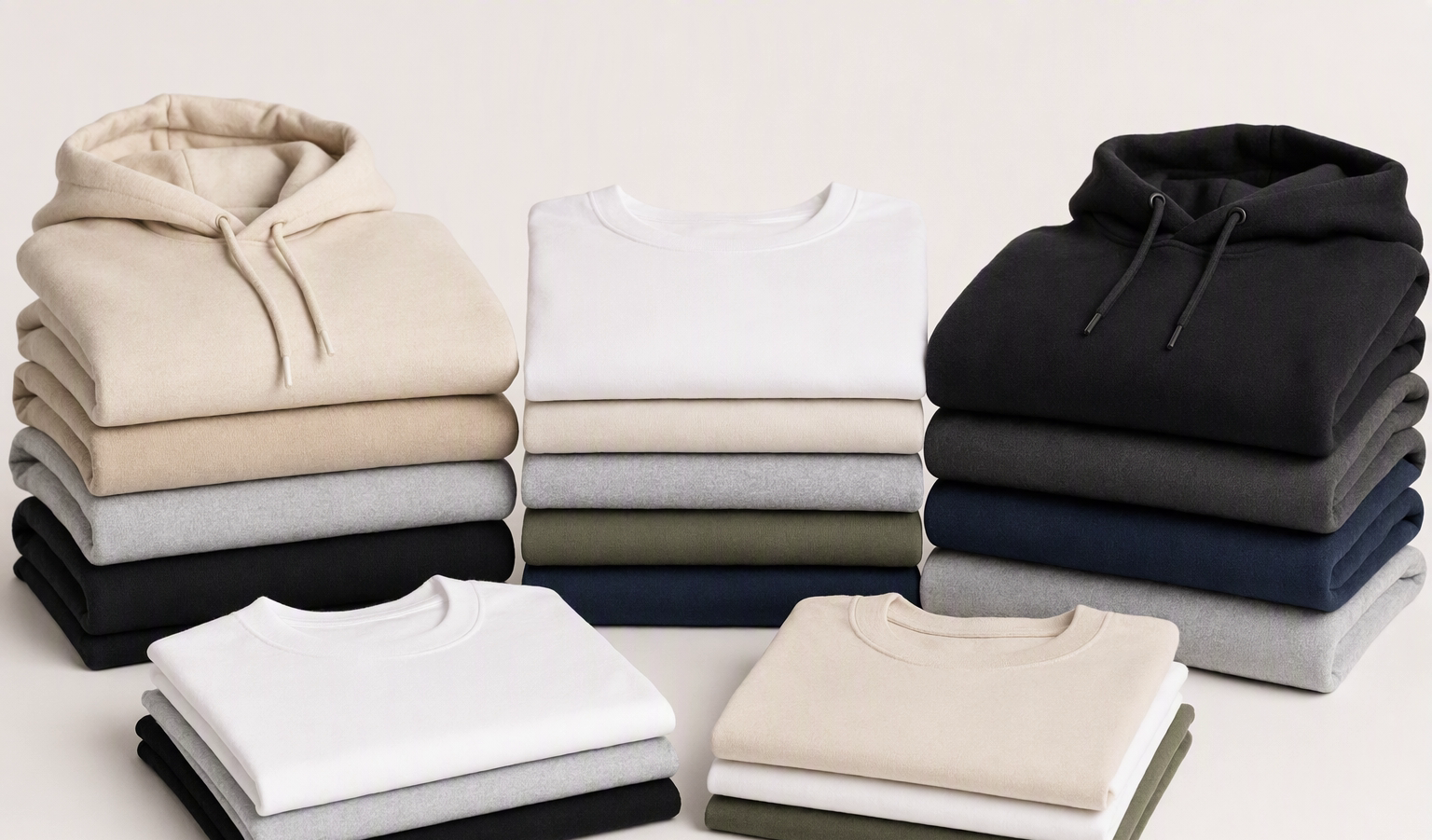
How to choose a white label clothing manufacturer
A low unit price means little if quality drifts between batches. When you shortlist white label clothing suppliers, verify these first:
- Real factory vs middleman – can they show production lines and control the process?
- Fabric knowledge – a good manufacturer advises on GSM, blend and finish for your use case.
- Sample discipline – a proper pre-production sample before bulk.
- Decoration durability – logos that survive washing; ask how they test.
- Sizing & grading – consistent measurements across the size run.
- Communication & lead-time honesty – realistic dates beat optimistic ones.
For white label specifically, judge suppliers on consistency and replenishment, not just the first sample. Ask: will this exact blank be available in six months when you reorder? What happens if they change the fabric or discontinue a colour? A good white label partner keeps a stable base catalogue and warns you before any change – because a brand’s reputation rests on the tee fitting the same way every season.
Also check what’s actually included in the price. Some white label quotes exclude labels, tags or packaging and add them later. Get a landed per-unit figure for the fully-branded garment so you can price your retail accurately.
Where to source: Fexwear vs Alibaba vs local
| Channel | Pros | Cons |
|---|---|---|
| Fexwear (direct factory) | In-house control, low MOQ, free design, direct pricing | Pre-production sampling takes a few days |
| Alibaba / marketplace | Huge supplier choice, low list prices | Variable quality, middlemen, hard to verify, MOQ surprises |
| Local manufacturer | Fast shipping, easy visits | Higher unit cost, limited fabrics & decoration |
The risks of sourcing from Alibaba (and how to avoid them)
- Middlemen posing as factories – many ‘manufacturers’ are trading companies that subcontract, adding cost and cutting you off from the line.
- Inconsistent, uncontrollable quality – it varies between suppliers and even between batches; without your own QC, defects reach customers.
- Sample-vs-bulk bait-and-switch – the approved sample looks great, the bulk quietly changes fabric, GSM or stitching.
- No accountability after payment – chasing fixes or refunds is slow and often fruitless.
- Misrepresented materials & certifications – claims that can’t be backed by certificates.
- MOQ and price surprises – list prices that jump once tooling, labels and colours are added.
Alibaba can work if you verify the factory, insist on a pre-production sample and arrange independent QC – but a direct in-house manufacturer gives you comparable pricing with real production control and accountability on every batch.
Products we white label we manufacture
- T-shirts & tops
- Hoodies & sweatshirts
- Joggers & sweats
- Sports bras & leggings
- Polos & teamwear
- Blank wholesale for your own printing
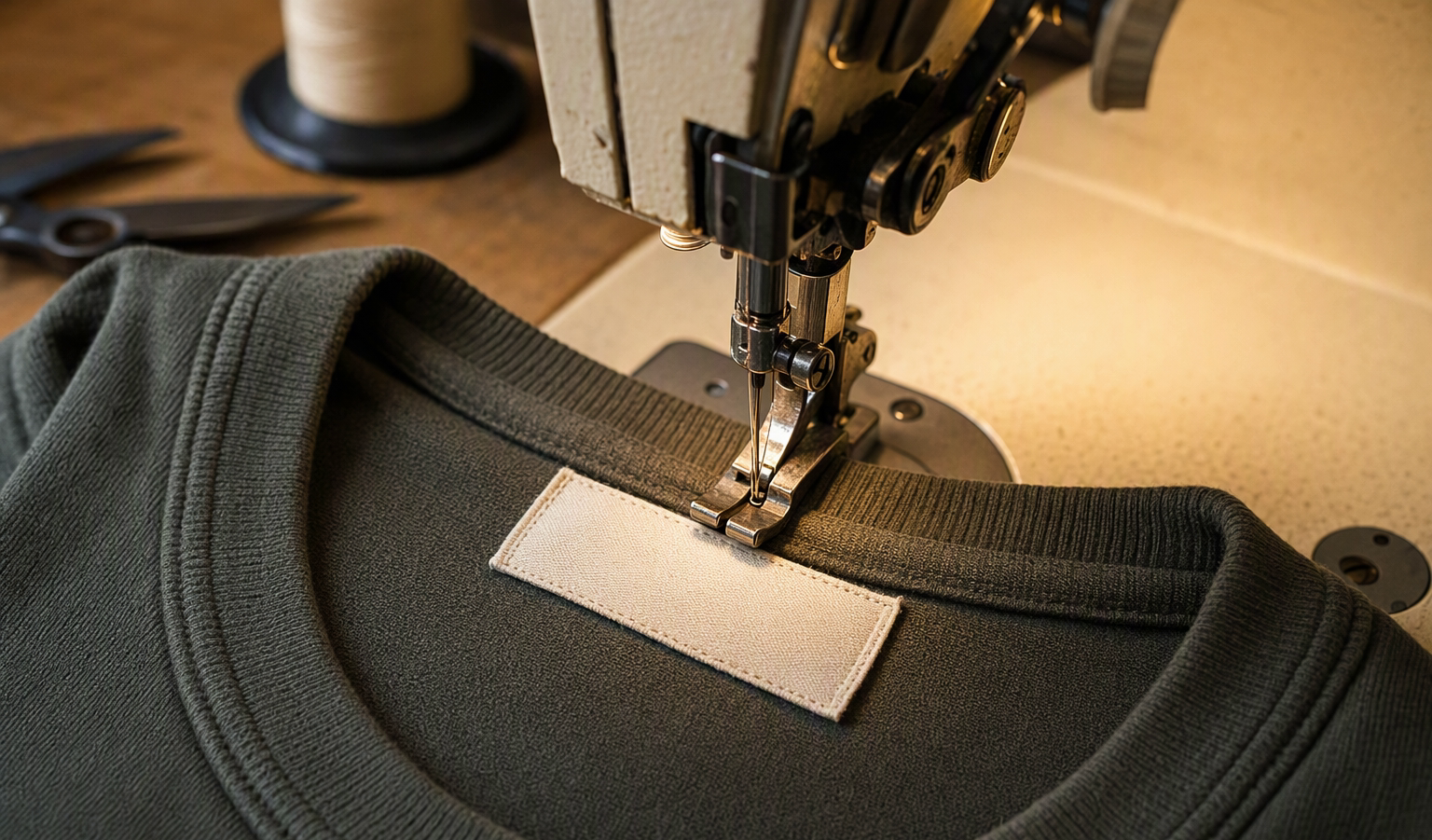
2026 trends
- Heavyweight (240-320 GSM) tees and hoodies for premium feel
- Oversized & boxy fits in streetwear
- Earth tones & washed finishes
- Recycled & organic fabric options as standard
- Matching sets (hoodie + jogger)
Construction & spec options
Every white label clothing is a set of decisions – pick each, or let us recommend a build for your price point:
| Spec | Options |
|---|---|
| Garment | Tee, hoodie, sweatshirt, jogger, bra, legging, polo |
| Fit | Regular, oversized, slim, cropped |
| Fabric knit | Single jersey, fleece, French terry, rib, interlock |
| Neckline | Crew, V, hood, mock |
| Trims | Woven label, hang tag, drawcord, elastic |
Fabrics & GSM
Pick the right base fabric for your market and price point:
| Fabric | Typical weight | Best for |
|---|---|---|
| Cotton / cotton-blend jersey | 160-240 GSM | Everyday tees & lifestyle |
| Poly-spandex dri-fit | 140-180 GSM | Gym & performance |
| Cotton-poly fleece | 280-380 GSM | Hoodies & sweats |
| Recycled poly / organic cotton | varies | Sustainable lines |
When you’re choosing a white label base, ask for the GSM and the blend, not just ‘cotton’. A 200 GSM combed-cotton tee behaves very differently from a 160 GSM carded one, and your customers feel it after one wash. We publish the GSM of every blank so you can build a range with a consistent, intentional hand-feel rather than a mixed bag.
What is GSM and how to choose fabric weight
GSM (grams per square metre) is the fabric’s weight – the biggest driver of how a garment feels. Lower GSM is lighter and cooler; higher GSM is denser, more opaque and more premium.
| GSM range | Feel | Best for |
|---|---|---|
| 120-160 GSM | Very light, breathable | Summer & performance |
| 160-220 GSM | Mid-weight, soft | Everyday & lifestyle |
| 220-300 GSM | Heavy, structured | Premium & streetwear |
| 300+ GSM | Thick, luxe drape | Designer heavyweight |
For white label, decide whether you’re selling everyday (lighter, cheaper) or premium (heavyweight) – it’s the fastest way to position your brand.
Blank vs private-label vs custom vs POD
| Model | What it is | Best for |
|---|---|---|
| Blank wholesale | Unbranded, you print | Fast, low-cost starts |
| Private label | Your fabric, fit & colours to spec | A signature product |
| Custom cut & sew | Developed from scratch | Full control & differentiation |
| Print-on-demand | Per-unit, no stock | Zero-risk testing |
Most brands start with blanks to test demand, then move to private label once a style sells. We support all paths.
A practical way to choose: if speed and price matter most, white label; if a distinctive fit or fabric is your edge, private label; if the silhouette itself is the product, cut and sew; if you can’t hold inventory at all, POD. Many of our clients run two or three of these at once across different parts of their catalogue.
Decoration & branding options
| Method | Durability | Best for |
|---|---|---|
| Screen printing | High | Bold logos, bulk, spot colours |
| DTG (digital) | Medium-High | Detailed, multi-colour, small runs |
| Embroidery | Very high | Premium chest & label marks |
| Dye-sublimation | Permanent | All-over polyester performance prints |
| Heat transfer | Medium | Fast, low-cost, small batches |
Because white label uses ready-made garments, branding is quick: add your neck label, hang tag and a chest or back print/embroidery, and a blank becomes your product.
For a cohesive brand, keep decoration consistent across the range: the same label placement, the same thread colours, the same print technique. That consistency is what makes a white label collection look designed rather than cobbled together. We’ll set a decoration spec once and apply it uniformly to every reorder.
MOQ, sampling & lead time
We keep MOQs low so you can test before committing. Sampling runs in stages – a proto sample, a fit sample, then a pre-production (PP) sample that locks fabric, colour and decoration. Standard samples turn around in days; bulk typically takes a few weeks once the PP sample is approved.
Because white label uses existing garments, you can often start with a genuinely small order, sell through, and reorder in a couple of weeks – which is why it suits drop-testers and seasonal drops. The trade-off is less differentiation, which is exactly why most brands graduate to private label once a style earns its place.
What drives the cost
- Fabric & GSM – performance and heavyweight fabrics cost more.
- Quantity – unit price falls as order size grows.
- Decoration – print size, colour count and embroidery complexity.
- Custom trims – woven labels, special elastics and packaging.
- Fit development – multiple sample rounds add time and cost.
- Logistics – destination, Incoterms and shipping method.
On white label, the biggest cost levers are fabric weight, decoration colour-count and label type. Moving from a 180 to a 220 GSM tee, or from a printed to a woven neck label, each add cents – but they also move your product from ‘cheap blank’ to ‘brand-quality’. The goal isn’t the lowest unit price; it’s the highest perceived value per dollar. We’ll show you where a small upcharge buys the most brand equity.
What to send us for an accurate quote
Include: style reference or sketch, target fabric & GSM, size range and measurement chart, colours, logo artwork (vector if possible) and print method, quantity, and target price. No tech pack yet? Send a photo or a competitor example and our design team will build it with you.
For white label, the fastest accurate quote comes from a short list: the styles, colours, sizes and quantities you want, plus your logo file and label preferences. You don’t need a full tech pack – the garments already exist – but the more specific your list, the tighter the price and the shorter the sample turnaround.
Sizing & measurement
For blanks we provide the manufacturer’s size chart; for private-label builds we grade a full run (XS to extended sizes, youth on request) and provide a size chart so every batch fits consistently.
Blank sizing runs vary between factories, so never assume your usual size. We send the exact measurement chart for each base garment and, for private-label builds, grade to your brand’s fit block. Locking sizing on the sample is what keeps returns low once you’re selling at volume.
Quality control
Every run is checked at three points – pre-production (approved PP sample and materials), inline (during sewing and printing), and final inspection before packing. You approve the PP sample, and that sample becomes the standard the whole order is judged against.
With white label, quality risk concentrates in the decoration and labels, not the blank (which is pre-made). We focus inspection on print registration and wash-fastness, label attachment and trim consistency, and colour matching to your approved sample – the details that make a branded blank look like a designed product.
Sustainable options
We offer recycled-polyester and organic-cotton blanks and lower-impact printing. If you make sustainability claims, verify the factory’s certificates (GOTS, GRS, OEKO-TEX) and ask for a transaction certificate for your order.
Even at white label level you can build a responsible range – organic cotton tees, recycled-polyester activewear, water-based prints and plastic-free packaging. Ask for the certificates behind each claim and we’ll provide them, so your ‘eco’ blanks are genuinely verifiable rather than a nicer-sounding label.
Common mistakes to avoid
- Choosing blanks by price only, ignoring GSM and shrinkage
- No size chart, so returns spike
- Decoration that washes off because the method didn’t suit the fabric
- Over-ordering before testing demand – start low-MOQ
- Skipping the sample and accepting a bulk that doesn’t match
The most common white label mistake is under-ordering a proven style and over-ordering an unproven one. Test broadly with small quantities, watch what actually sells, then concentrate your budget on the winners. Suppliers who push you to ‘commit to volume for a better price’ before you have sales data are optimising for their factory schedule, not your cash flow.
Who we manufacture for
- New DTC & lifestyle brands
- Boutiques & retailers
- Gyms, studios & trainers
- Amazon & Shopify sellers
- Promo, events & corporate wear
Each buyer starts differently. A boutique wants small, varied drops; a gym wants durable performance pieces in team colours; an Amazon seller needs a size chart tight enough to keep returns low and packaging that survives freight. The white label base is the same – the branding, MOQ and documentation around it change, and we set those to match how you actually sell.
Why brands choose Fexwear
- In-house factory & direct pricing
- Low MOQ to start small
- Free branding & design support
- Fast turnaround
- Full customisation of labels & packaging
Order timeline: enquiry to delivery
| Stage | Typical time |
|---|---|
| Enquiry & quote | 1-2 days |
| Proto / fit sample | 3-7 days |
| PP sample approval | 3-5 days |
| Bulk production | 2-4 weeks |
| QC & packing | 3-5 days |
| Shipping (air/sea) | 3-30 days by method |
Because the garments already exist, white label is our fastest route to stock – often 2-4 weeks all-in for Level 1-2 branding, versus 5-8 weeks once you add custom fabric and patterns. If you’re working to a launch date or a seasonal drop, tell us the deadline up front and we’ll build backwards from it.
How to start
- Pick your styles from our catalogue
- Send your logo & branding spec
- Approve a branded sample
- Bulk production, QC & worldwide shipping
Request a quote
Tell us your white label clothing, fabric and quantity and we’ll come back with pricing, MOQ and a timeline. Related: custom tank tops, gym wear and how to measure & size. Contact Fexwear →
Branding levels: from neck tag to fully bespoke
| Level | What you get | Typical MOQ | Best for |
|---|---|---|---|
| 1 · Blank + print | Unbranded garment + your chest/back print | Lowest | Testing designs, promo |
| 2 · Custom labels | Your woven neck label + hang tag + packaging | Low | Launch a real brand look |
| 3 · Private label | Your colours, fabric weight & trims to spec | Medium | A signature product |
| 4 · Cut & sew | Fully custom pattern & fit from scratch | Higher | Full differentiation |
Most brands start at Level 1-2 to test the market, then move up to Level 3-4 once a style proves out. You can mix levels across your range – hero pieces bespoke, basics white label.
The reason we split branding into levels is that the economics and timelines differ sharply. Level 1-2 can ship in days because the garment already exists; Level 3-4 need pattern development and fabric sourcing, so add a few weeks and a higher MOQ. A smart launch strategy is to start at Level 2 (blanks with your label) to validate demand fast, then invest in Level 3-4 only for the styles that prove themselves – so your cash goes behind winners, not guesses.
White label product catalogue & materials
Our ready-made base garments span everyday and performance: heavyweight cotton tees (220-240 GSM), brushed fleece hoodies and crewnecks (280-380 GSM), French-terry joggers, squat-proof poly-spandex leggings and sports bras, plus polos and teamwear. Colours, fits (regular/oversized/cropped) and a full XS-extended size run are available, so you can build a cohesive collection from proven blocks.
Fabric choice is where white label brands most often get it wrong. A 180 GSM tee feels thin and sells cheap; a 220-240 GSM tee feels substantial and supports a premium price, for only a little more per unit. We’ll recommend the weight and blend per garment so your range feels intentional rather than a grab-bag of whatever was cheapest to stock.
Reordering & scaling your line
White label’s real advantage is repeat speed: once a style sells, you reorder the same blanks and branding with consistent fabric and sizing – no re-development. We help you plan colour/size replenishment, hold stock of fast movers, and keep decoration files on record so every batch matches the last.
Reorder discipline is what turns a single hit into a brand. Keep a record of every approved spec – fabric, GSM, colour code, print file, label – so a reorder is a one-line request, not a re-explanation. We hold your decoration files and approved samples on record, so your size run and colour stay identical from batch one to batch twenty.
How to build a white label brand that doesn’t look generic
The fear with white label is that everyone else has the same blank. The difference between a generic tee and a brand people pay a premium for is almost never the base garment – it’s the system built around it. Fabric weight is the first signal: a 220-240 GSM tee simply hangs better and feels more substantial than a thin 160 GSM one, and customers notice within seconds. Then it’s the finishing details – a woven neck label instead of a printed one, a considered hang tag, matching colourways across the range – and finally the photography and copy that present the blank as a deliberate product rather than a stock item.
The brands that succeed with white label treat it as a starting point, not a ceiling. They launch a tight, coherent range so nothing looks random, own a clear aesthetic across every piece, and then move their best sellers to private label – custom fabric, fit and trims – so the winners become genuinely theirs. That progression is exactly why we structure white label in levels: you validate cheaply and quickly, then invest in differentiation only where the market has already told you it’s worth it.
The economics of white label: margins, MOQ and cash flow
White label’s real advantage is cash-flow shape. Because the garments already exist, you can start with a genuinely small order, sell through, and reorder in a couple of weeks – so you’re not sinking thousands into inventory of an unproven design. That flexibility is worth a lot to a new brand, even if the per-unit price is a little above a huge committed order. The mistake is optimising for the lowest unit price by over-ordering, which converts your cash into stock that may never sell.
Around that unit price, build your retail from the landed cost, not the quoted garment price. Landed cost includes the blank, your branding (labels, tags, print or embroidery), packaging and freight to your door or your 3PL. Mark up from there to hit a real gross margin after payment fees, returns and shipping. Suppliers who quote only the garment make your margins look better than they are; ask for the landed number and your pricing decisions get much easier.
Glossary
| Term | Meaning |
|---|---|
| GSM | Grams per square metre – fabric weight |
| Tech pack | Spec sheet with measurements, fabrics & artwork |
| Proto / fit / PP sample | Prototype, fit-check and pre-production samples |
| Sublimation | All-over dye print fused into polyester |
| Serging / overlock | Seam finishing that prevents fraying |
| AQL | Acceptable Quality Level – inspection standard |
| Incoterms | Shipping terms like FOB, EXW, DDP |
| Cut & sew | Fully custom from fabric roll, not printing blanks |
Frequently Asked Questions
What is white label clothing?
White label means a manufacturer produces ready-designed garments that you brand and sell under your own label – faster and lower-cost than full custom development.
What's the MOQ for white label apparel?
We support low MOQ so you can start small and reorder winners; exact MOQ depends on style, colour and branding – send your list and we'll confirm.
Can I add my own label and packaging?
Yes – custom woven neck labels, hang tags, printed care labels and branded packaging turn a white label garment into your own brand.
White label vs private label vs custom?
White label = existing designs you brand; private label = your fabric/fit/colours to spec; fully custom = built from scratch. Most brands start white label and scale to private label.
How long does a white label order take?
Because designs and fabrics are ready, lead times are shorter than custom – typically a few weeks including branding and QC.
Which products can I white label?
T-shirts, hoodies, sweatshirts, joggers, sports bras, leggings, polos and teamwear in cotton, fleece and performance fabrics.
Is white label good for Amazon or Shopify?
Yes – low MOQ and fast turnaround make white label ideal for testing listings and reordering winners without big inventory risk.